
The wordmark above is \sqrt{\mathrm{Vinculum}}, typeset by Vinculum itself.
Native LaTeX math typesetting for Apple, Linux, Windows, Android, and WebAssembly. Real glyph shapes, TeX metrics from the font's MATH table, a device-independent scene IR — no MathJax, no KaTeX, no WebView, zero dependencies on the default build.




Vinculum parses LaTeX math into a TeX-style atom tree and typesets it with an
OpenType MATH font — five bundled (Latin Modern, TeX Gyre Termes, TeX
Gyre Pagella, STIX Two, and the sans-serif Fira Math) or any OTF you supply — following Knuth's algorithm
(Appendix G of The TeXbook) with everything parsed from the font's MATH
table at runtime: all 56 layout constants, per-glyph italic corrections
and accent attachment points, cut-in kerning staircases, delimiter size
variants, and glyph assemblies for arbitrarily tall fences and radicals.
Layout is
platform-free and emits a device-independent MathScene
of positioned primitives — TeX's DVI in miniature — which a thin CoreGraphics
renderer turns into a baseline-aligned NSTextAttachment (or draws into any
CGContext you own).
A vinculum is the bar in a fraction, the line over a root — the stroke that binds an expression together. Vinculum is the native math engine extracted from Quoin, sibling to MermaidKit.
Rendering math in a native app has usually meant embedding a JavaScript
math renderer in a WKWebView. Vinculum typesets natively instead:
- No WebView. No JavaScript runtime, no HTML/CSS reflow, no bridging layer, no web-content process to spin up per equation.
- Real text integration. Output is an
NSTextAttachmentthat flows inline in anNSTextView/UITextView/ TextKit layout, sharing the text system's baseline, selection, and line-breaking — a WebView snapshot never does. - The font is the authority. Everything TeX reads from a font,
Vinculum reads from the font: the full
MathConstantssub-table, per-glyph italic corrections and accent attachment points, cut-in kerning, size-variant ladders, and glyph assemblies. - Deterministic, headless-testable geometry (see the golden-image suite and the Linux-tested layout engine), instead of pixels that depend on a web engine version.
- On-device and private. Nothing leaves the machine.
- Trade-off: Vinculum covers the everyday LaTeX math most documents
actually use, not every macro package a web renderer ships. If you need
mhchem, siunitx,
\href, or arbitrary embedded HTML, a WebView still wins. Everything unsupported degrades to a named fallback — never a broken half-render.
Swift Package Manager. Add the dependency:
// Package.swift
dependencies: [
    .package(url: "https://github.com/2389-research/Vinculum.git", from: "2.0.0"),
]
For the Linux raster backend (Silica/Cairo/FreeType), add
traits: ["LinuxRaster"]to the dependency — it is off by default so every other consumer keeps a Silica-free dependency graph. See docs/LINUX.md.
Then pick your product(s):
.target(name: "MyApp", dependencies: [
    .product(name: "VinculumRender", package: "Vinculum"),  // Apple: parse + draw
    // .product(name: "VinculumLayout", package: "Vinculum"), // platform-free layout only
])- VinculumRender — the renderer. On Apple platforms it draws with
CoreText/CoreGraphics (attachments, views, the one-call API); on Linux
it draws with Silica/Cairo/FreeType and produces PNGs
(
MathSilicaRenderer.renderPNG, see docs/LINUX.md). - VinculumLayout — platform-free (Foundation only, builds on Linux):
parsing, macros, and all typesetting geometry, emitting a
MathScene. Use it alone if you supply your own measurer and renderer.
The 0.24 line is the font-truth release: everything the OpenType MATH table offers, Vinculum now reads and uses — for four bundled fonts or any math OTF you supply.
- All metrics from the font, at runtime — the full 56-value
MathConstantssub-table (axis height, rule thicknesses, script scales, every shift and clearance), fontTools-verified and fixture-pinned on Linux CI. - Per-glyph typography — italic corrections split superscripts from
subscripts and tuck
\int's lower bound under its slant; accents sit on each glyph'stopAccentAttachment; cut-in kerning staircases nestle scripts into the base glyph's corners (STIX Two ships kern data for 233 glyphs). - Glyph assembly — arbitrarily tall fences and radicals are BUILT from the font's end caps and extenders at constant stroke weight; nested radicals step through purpose-drawn size variants exactly like TeX.
- The TeX style lattice — display/text/script/scriptscript with
cramping, style-correct constant pairs, spacing suppression in scripts,
and the
\displaystylecommand family. - Four bundled fonts — Latin Modern, TeX Gyre Termes, TeX Gyre
Pagella, STIX Two — plus
MathFont(url:)for your own (see docs/FONTS.md). - A real product surface —
VinculumLabel/ SwiftUIMathView, LaTeX round-tripping (MathNode.toLaTeX()), parse diagnostics with source ranges, and spoken math: VoiceOver reads every equation ("x equals the fraction negative b plus or minus…"). - Hardened — the whole pipeline is fuzz-tested (grammar, mutation, and depth-attack corpora) and never crashes on adversarial input.
See CHANGELOG.md for the full arc.
Whole documents — prose with embedded math (markdown notes, chat
messages, LLM output) in one call. All four delimiter styles ($…$,
$$…$$, \(…\), \[…\]), document-scoped \newcommand macros, and
unsupported math stays visible as styled source:
textView.textStorage?.setAttributedString(
    MathText.attributedString(from: modelResponse))
The one-liner — a drop-in view (AppKit/UIKit), or SwiftUI:
let label = VinculumLabel()
label.latex = #"x = \frac{-b \pm \sqrt{b^2 - 4ac}}{2a}"#
// label.font = .stixTwo · .termes · .pagella — or MathFont(url:) for your own

// SwiftUI:
MathView(#"e^{i\pi} + 1 = 0"#).mathFont(.pagella)
Or one call turns LaTeX into an inline attachment for a text view:
import VinculumRender

// Returns nil when the LaTeX contains unsupported commands, so the host keeps
// its own fallback and a document never renders half-broken.
let attributed = MathImageRenderer.attachmentString(
    latex: #"\frac{-b \pm \sqrt{b^2 - 4ac}}{2a}"#,
    display: true,           // display style (stacked limits, larger parts)
    mathTheme: .light,       // .light / .dark / your own
    baseSize: 15)            // point size the surrounding text uses

if let attributed {
    textView.textStorage?.append(attributed)   // flows on the text baseline
}
Prefer to drive the pipeline yourself? Layout is platform-free and returns a
device-independent MathScene; you decide where to draw it:
import VinculumLayout   // parse + layout
import VinculumRender   // CoreText measurer + CGContext renderer

let node = MathParser.parse(#"\sum_{i=1}^{n} i^2"#)
guard MathParser.isFullySupported(node) else {
    // name the culprit for a fallback caption:
    // MathParser.unsupportedCommands(in: node)  →  ["\\foo", …]
    return
}

// The delimiter provider is optional; pass it in for MATH-table tall-fence
// variants, or omit it (defaults to nil) to scale base glyphs.
let engine = MathLayoutEngine(
    measure: CoreTextMeasurer.make(),
    baseSize: 15,
    delimiters: CoreTextDelimiterProvider.make())
let scene = engine.layout(node, display: true)   // MathScene: width/ascent/descent + primitives

// Draw into any y-up CGContext (an image, a PDF page, a custom view):
MathSceneRenderer.draw(scene, theme: .dark, in: cgContext, at: penPoint, font: .latinModern)
MathImageRenderer.attachmentString gives you the cached attachment.
MathSceneRenderer.draw is the primitive you build images or PDF pages from —
Vinculum ships no PDF convenience wrapper; you own the context.
One engine, four bundled OpenType math fonts — pick per render, or load
any .otf that carries a MATH table. Every metric, kern, variant, and
assembly comes from the selected font. CI regenerates this specimen on
every push (deep dive: docs/FONTS.md):
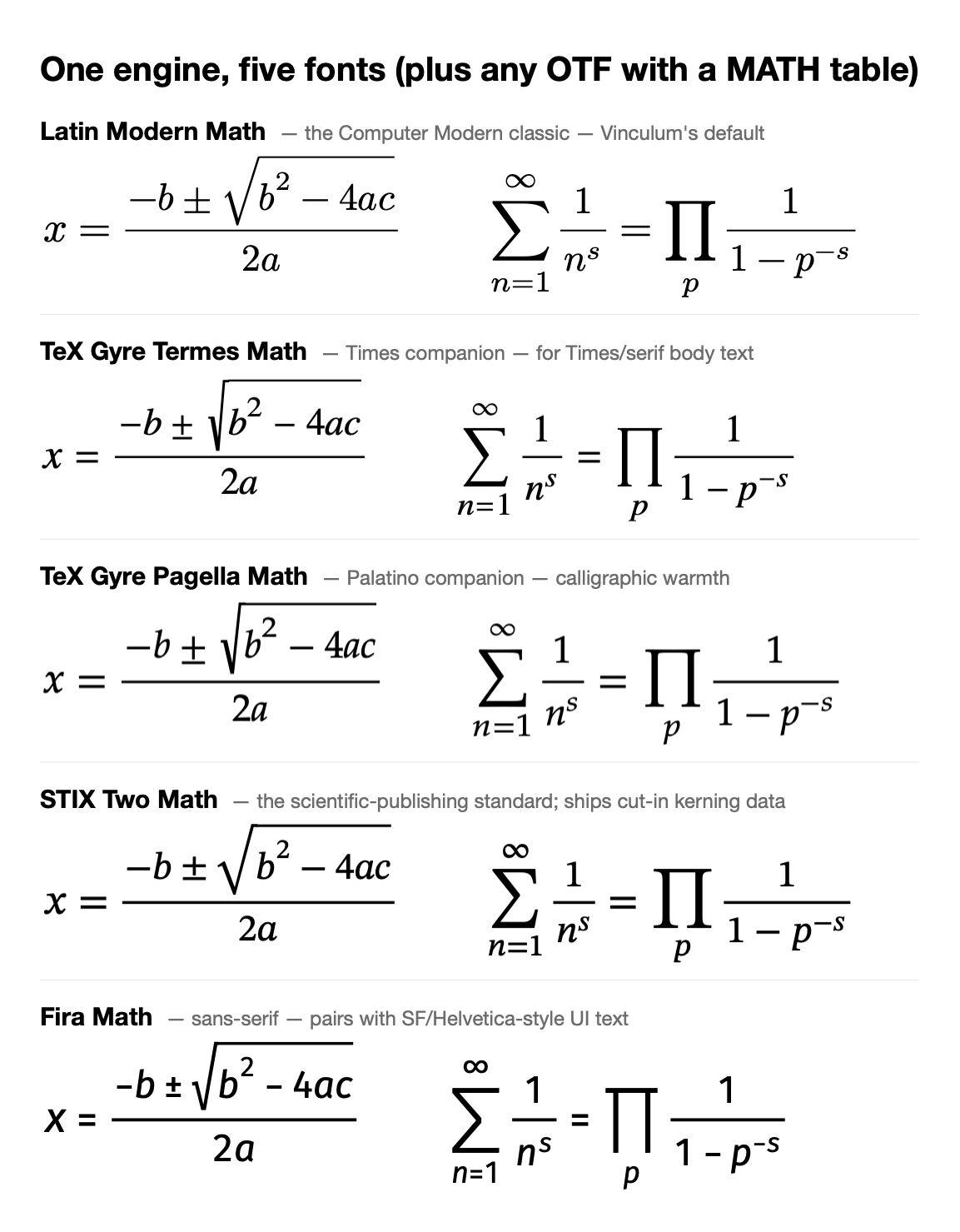
| Font | Pair it with | Character |
|---|---|---|
.latinModern (default) |
Computer Modern / LaTeX-look documents | The classic TeX voice |
.termes |
Times, Georgia, serif body text | Narrow, upright, editorial |
.pagella |
Palatino, Book Antiqua | Calligraphic warmth |
.stixTwo |
Times-family scientific publishing | The STIX standard; richest kerning data |
.firaMath |
SF / Helvetica / modern UI text | Sans-serif — visibly distinct from the serif four |
label.font = .pagella                          // VinculumLabel
MathView(#"e^{i\pi}+1=0"#).mathFont(.stixTwo)  // SwiftUI
MathImageRenderer.attachmentString(latex: src, display: true,
                                   mathTheme: .light, baseSize: 15,
                                   font: .termes)

// Bring your own (must carry an OpenType MATH table):
if let custom = MathFont(url: fontURL) { label.font = custom }- API documentation ships as a DocC catalog — open the package in Xcode and Product ▸ Build Documentation for the full curated reference (getting started, the document pipeline, fonts, the rendering pipeline).
- Reference docs in the repo: docs/FONTS.md, docs/ALGORITHM.md (the rule-by-rule TeX Appendix G audit), docs/ARCHITECTURE.md, docs/COMMANDS.md and docs/COVERAGE.md.
- Try it live:
swift run VinculumDemoopens a macOS window — paste any text with math in it (an LLM response works beautifully), switch fonts, toggle dark rendering.
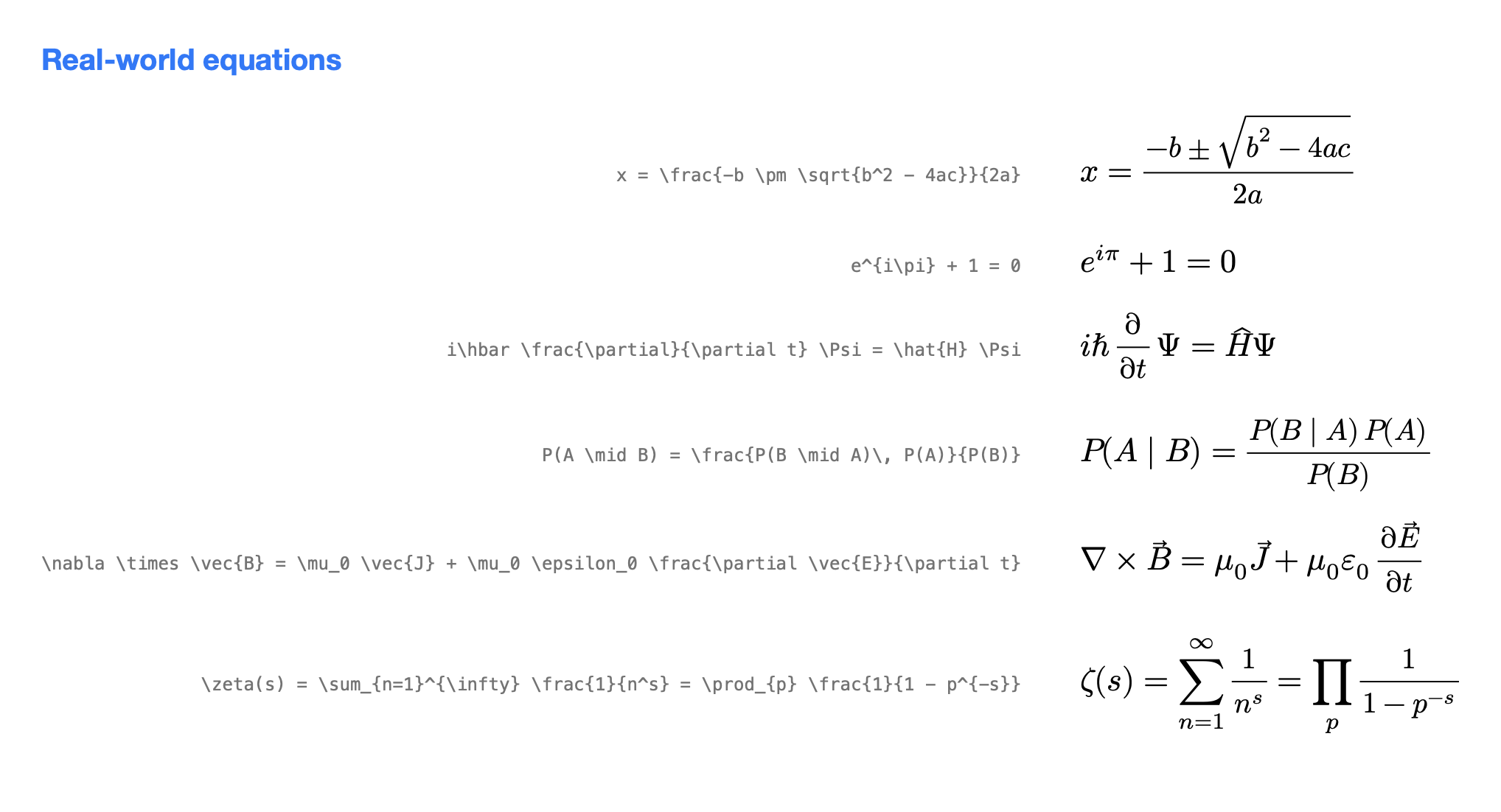
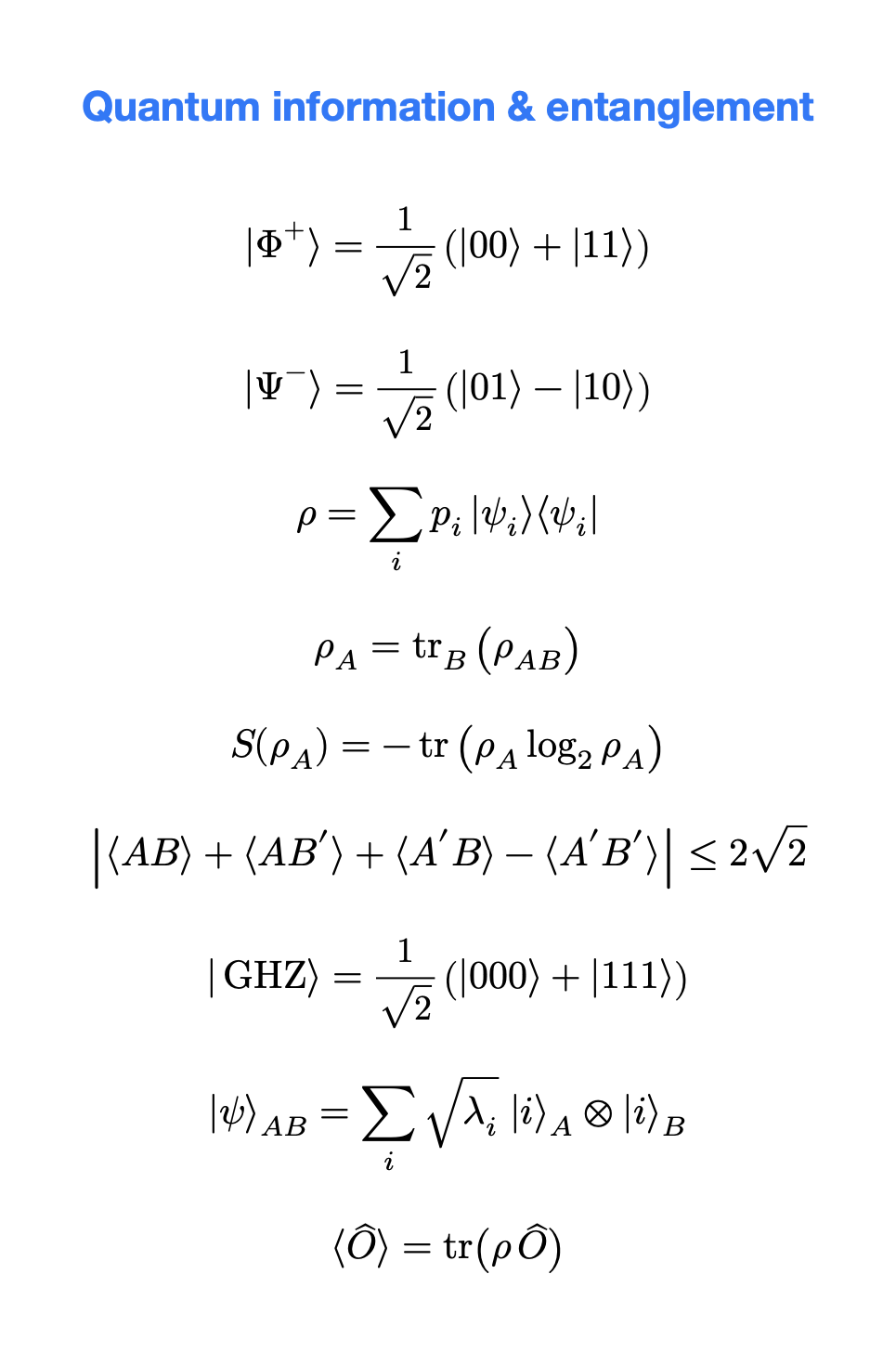
Vinculum renders the everyday math people actually write. CI regenerates
these posters on every push to main and publishes them to the orphan
gallery branch, so
they always show the current rendering — no stale screenshots:
To regenerate them locally, point the gallery test at an output directory:
VINCULUM_GALLERY_DIR=/tmp/vinculum-gallery \
  swift test --filter GalleryGenerator/testGenerateGallery
# and the multi-page stress corpus:
VINCULUM_STRESS_DIR=/tmp/vinculum-gallery \
  swift test --filter MathStressGallery/testGenerateStressPages
The gallery posters cover:
| Poster | Shows |
|---|---|
01-core.png |
Fractions, roots, sub/superscripts, big operators with stacked limits |
02-structures.png |
Auto-sized \left…\right fences, matrices, cases, aligned |
03-notation.png |
Accents, \binom, \overbrace/\underbrace, \xrightarrow, \substack, alphabets, color |
04-equations.png |
Real-world equations: quadratic, Euler, Schrödinger, Bayes, Maxwell, the zeta functional product |
05-macros.png |
Document-scoped \newcommand in action |
06-symbols.png |
Standalone delimiters and the extended symbol set |
07-fonts.png |
The same equations in all four bundled math fonts |
08-font-glyphs.png |
Glyph-by-glyph font comparison (fonts as columns) |
09-font-alphabets.png |
Alphabet/script sub-specimen per font |
arch-*.png |
Figures for docs/ARCHITECTURE.md: spacing, delimiters, styles, fallback |
cmd-arrows.png |
The extensible \x…arrow family, each head drawn distinctly |
arch-ssty.png |
ssty optical scripts — script glyphs redrawn, not just scaled |
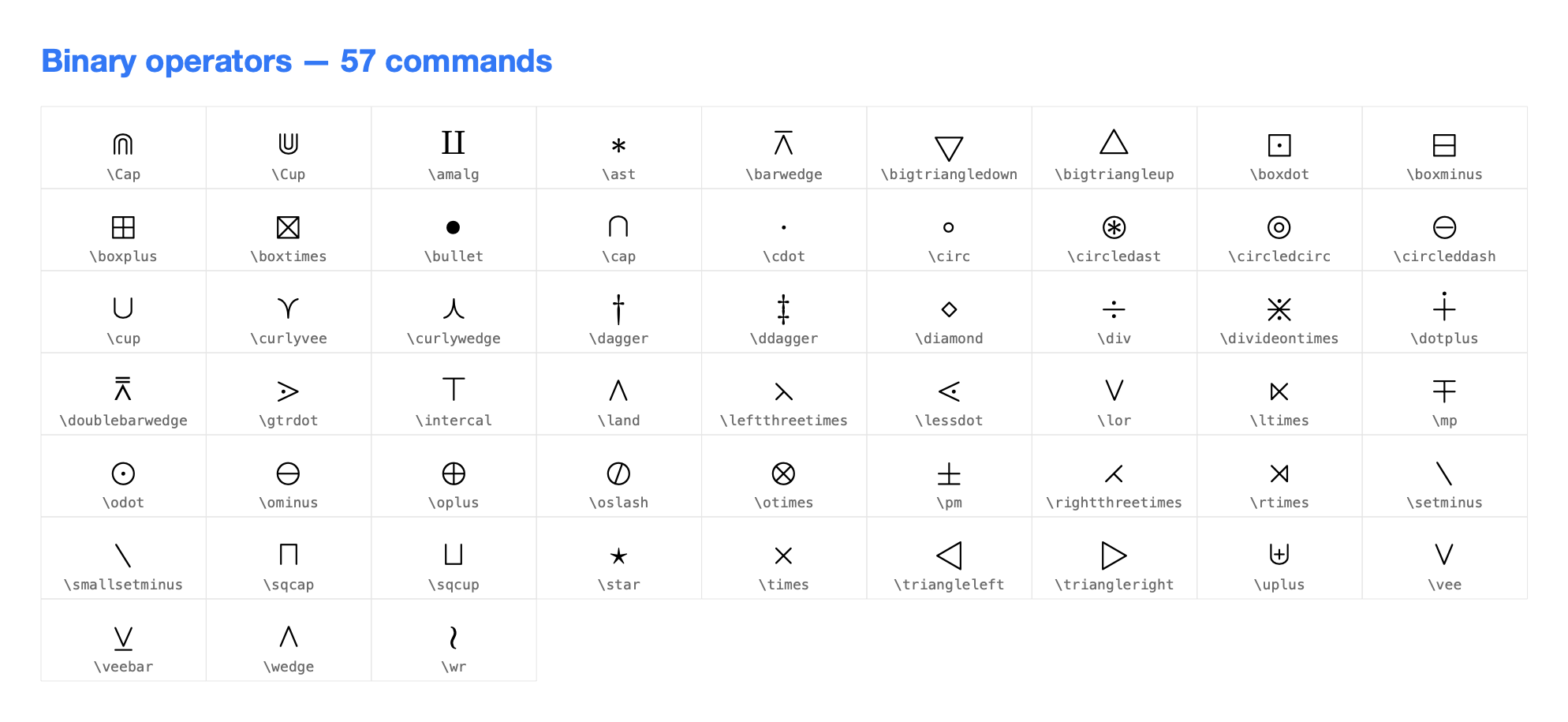
The complete command charts. A visual companion to
docs/COMMANDS.md: every command rendered — a font-specimen
grid for each atom class (sym-relations.png, sym-binary.png,
sym-operators.png, sym-ordinary.png, sym-functions.png, …) plus
source-beside-render structural examples (cmd-structural.png), all on the
gallery branch and regenerated by CI:
The repo also carries ~87 golden reference PNGs under
Tests/fixtures/math-golden/(one per construct:quadratic.png,integral.png,pmatrix.png,mathbb.png,overbrace.png, …) that the render tests diff against, plus a 66-equation stress corpus (MathStressGallery) held at 100% native coverage by a CI ratchet. Thegallerybranch's raw URLs are stable, so docs and the website can embed the always-current posters directly.
Example expressions, all natively rendered:
x = \frac{-b \pm \sqrt{b^2 - 4ac}}{2a}
e^{i\pi} + 1 = 0
\int_{0}^{\infty} e^{-x^2}\, dx = \frac{\sqrt{\pi}}{2}
\zeta(s) = \sum_{n=1}^{\infty} \frac{1}{n^s} = \prod_{p} \frac{1}{1 - p^{-s}}
\nabla \times \vec{B} = \mu_0 \vec{J} + \mu_0 \epsilon_0 \frac{\partial \vec{E}}{\partial t}
\begin{pmatrix} a & b \\ c & d \end{pmatrix}Native = renders with real geometry. Everything unsupported degrades to a
named source fallback (isFullySupported returns false; the render API
returns nil) — never a broken half-render. Full, code-checked detail with
examples in docs/COVERAGE.md; the exhaustive
command-by-command index (every supported \command) is in
docs/COMMANDS.md.
| Feature | Status | Notes |
|---|---|---|
Fractions \frac, \cfrac, \genfrac |
✅ | \cfrac is a true full-size continued fraction ([l]/[r] alignment); \genfrac is the general 5-arg form (custom fences, rule on/off, forced style) |
Roots \sqrt, \sqrt[n]{} |
✅ | Optional degree |
Sub/superscripts ^ _ |
✅ | Nested, both, on any atom; cramped-style lowering modeled |
| Big operators with limits | ✅ | \sum \prod \bigcup \bigcap … stack limits in display; \int \oint keep side-scripts (TeX \nolimits) |
Named operators \lim \max \min \sup \det \gcd … |
✅ | 37 function names; the \lim family stacks its limit underneath in display |
\operatorname, \operatorname* |
✅ | Upright custom operator; * stacks limits in display |
| Symbols & Greek (~400 commands) | ✅ | Correct TeX atom classes → real inter-atom spacing |
| Matrix environments | ✅ | pmatrix bmatrix Bmatrix vmatrix Vmatrix matrix (+ *[r] alignment), cases, smallmatrix, substack |
| Aligned display environments | ✅ | aligned align alignat split gather gathered multline; \tag/\tag*/\notag |
array column specs & rules |
✅ | {l c r | c} alignment + | vertical rules + \hline/\cline — augmented matrices, bordered/truth tables |
| Math alphabets | ✅ | \mathbb \mathcal \mathscr \mathfrak \mathsf \mathtt \mathbf \boldsymbol \pmb; \mathcal/\mathfrak/\mathscr cover letters (not digits), \mathbf uses a bold system font |
| Accents | ✅ | Point (\hat \vec \bar \dot \ddot \acute …), stretchy (\widehat \widetilde \widecheck), rules (\overline \underline) |
| Over/under constructs | ✅ | \overbrace/\underbrace, \overbracket/\underbracket, \overparen/\underparen, \overrightarrow & vector arrows |
\binom / \dbinom / \tbinom |
✅ | Ruleless paren-fenced; d/t force display/text size |
| Extended big operators | ✅ | \iiint \oiint \coprod \bigsqcup \bigvee \bigwedge \bigoplus \bigotimes \bigodot … |
\xrightarrow / \xleftarrow family |
✅ | Stretchy, with over {} and under [] labels |
| Boxes & rules | ✅ | \boxed \fbox \colorbox \fcolorbox \rule \raisebox; \phantom \hphantom \vphantom \smash \mathrlap \mathllap \mathclap |
\color / \textcolor |
✅ | Braced {name}{body} form and stateful \color{name} for the rest of the group; named + #rrggbb |
| Atom-class overrides | ✅ | \mathbin \mathrel \mathop \mathord \mathopen \mathclose \mathpunct |
| Strikes & negation | ✅ | \cancel \bcancel \xcancel \cancelto; \not slashes any relation (\not\subset → ⊄) |
\text \mathrm \textrm |
✅ | Upright; interior spaces preserved (\text{if } x), inline math via \text{$…$} |
Primes f', f'' |
✅ | Raised, coalesced primes |
Direct Unicode math (∫ ∑ ≤ α) |
✅ | Classed like its command spelling |
\newcommand \renewcommand \def |
✅ | Document-scoped, #1…#9, recursion-capped |
Spacing \, \: \; \! \quad \qquad \hspace \kern \mkern |
✅ | mu-unit spacing from the MATH table |
\dfrac / \tfrac / \dbinom / \tbinom |
✅ | Force display/text style regardless of context |
\big \Big \bigg \Bigg (+l/r/m), \middle |
✅ | Enlarge the delimiter 1.2–3×, or a growing \middle separator, with correct opening/closing/relation spacing |
Auto delimiters \left … \right, \middle |
✅ | Auto-sizes fences to the body; tall ( ) [ ] { } use MATH-table size variants, others scale |
\pmod / \bmod / \pod |
✅ | a \equiv b \pmod{n}, a \bmod n |
\sideset, \DeclareMathOperator, \mathchoice |
❌ | Degrade to source fallback |
Harpoon accents, \utilde |
❌ | Degrade to source fallback |
| Arbitrarily-tall extensible fences | Very tall non-()[]{} delimiters scale continuously (slightly heavy strokes) rather than assembling from font pieces |
|
mhchem \ce, siunitx, \href, \includegraphics, \verb, \begin{CD} |
❌ | Out of scope by design |
The short tail is honest and documented: extensible delimiter assembly
(arbitrarily-tall fences built from font pieces) and the remaining variant
glyphs (⟨ ⟩ ‖ ⌈ ⌋), a few macro-table operators (\DeclareMathOperator,
\sideset, \mathchoice), harpoon accents, and packages that are diagrams or
chemistry rather than math (\begin{CD}, mhchem, siunitx). Everything there
degrades to a named source fallback, never a broken render.
Vinculum mirrors TeX's device-independent split (and MermaidKit's layout/render seam): layout decides what to draw; a renderer decides how.
flowchart LR
    L["LaTeX"] --> LAYOUT["VinculumLayout<br/>parse + typeset"]
    LAYOUT --> S["MathScene<br/>device-independent IR"]
    S --> RENDER["VinculumRender<br/>CoreText + CGContext"]
    S --> SVG["MathSVGRenderer<br/>server-side SVG"]
    RENDER --> OUT["attachment · label · SwiftUI view"]
Stage-by-stage sub-diagrams live in docs/ARCHITECTURE.md.
- VinculumLayout (Foundation only, Linux-buildable) owns parsing, macro
expansion, and all typesetting geometry.
MathLayoutEnginemeasures glyphs through an injectedMathTextMeasurerclosure (and optionalMathDelimiterProvider) and emits aMathSceneof positioned primitives (MathElement: glyph runs, filled rules, stroked paths) inMathColor. No CoreText, no CoreGraphics — just geometry. The font's MATH-table constants live inMathConstants; Vinculum's own drawing proportions (radical hook, brace arcs, arrowhead) live inMathLayout. Every number is named. - VinculumRender (Apple: CoreText/CoreGraphics; Linux: Silica/Cairo/FreeType) is the platform seam:
CoreTextMeasurerimplements the measurer viaCTLine,CoreTextDelimiterProviderreads MATH-table delimiter size variants,MathSceneRendererdraws a scene into aCGContext,MathFontbundles Latin Modern Math,MathThemeis the host coupling (ink color + appearance), andMathImageRendererorchestrates measure → layout → render into a cached attachment.
The measurer seam is why layout is headless- and Linux-testable: unit tests inject a mock measurer and assert on exact geometry, no display required. Deep dive in docs/ARCHITECTURE.md.
Math is monochrome ink on a transparent attachment, so the host coupling is tiny — a color and the appearance it targets:
struct MathTheme {
    let ink: PlatformColor      // every stroke/glyph, unless \color overrides a subtree
    let prefersDark: Bool       // pins the appearance while rasterizing + keys the cache
}
Use .light / .dark, or build one from your design system with
MathTheme(ink:prefersDark:). \color / \textcolor override the ink
per-subtree during layout. That's the whole surface — see
docs/INTEGRATION.md.
The layout engine is platform-free (Foundation only), so the same typesetting — provably byte-identical geometry — drives every target. What differs is the last mile (how pixels get drawn) and how you integrate.
- macOS 14+, iOS 17+, visionOS 1+, tvOS 17+ — full package (VinculumRender),
CoreText/CoreGraphics. SwiftUI
MathView,VinculumLabel,NSTextAttachment. - Linux — full rendering via Silica/Cairo/FreeType (
MathSilicaRenderer, docs/LINUX.md), server-side SVG (MathSVGRenderer), or VinculumLayout alone (parsing + geometry; supply your own measurer/renderer). - Windows — native rendering through the C ABI + FreeType, drawn with
SkiaSharp, and a drop-in
VinculumMathViewcontrol for both WPF and WinUI 3. Ships as self-contained NuGet packages (Vinculum.Rendering,Vinculum.Windows.Wpf,Vinculum.Windows.WinUI). See windows/README.md. - Android — the C ABI as a JNI library with a Kotlin
VDL1decoder +Canvasrenderer; on-device rendering proven. See docs/ANDROID.md. - WebAssembly —
VinculumLayoutcross-compiles towasm32-unknown-wasip1and renders SVG (a ~9.5 MB module on FoundationEssentials).
Windows, Android, and WebAssembly all reuse the one seam — a fully-resolved scene
crosses the C ABI as the language-neutral VDL1 binary, decoded by
per-platform renderers whose wire agreement is CI-gated
(docs/DISPLAYLIST.md). CoreText and FreeType are measured
to produce byte-identical geometry.
- Swift 6.2+ toolchain, Swift 6 language mode, strict concurrency. Zero third-party dependencies on the default build (the Linux Cairo backend and the Windows native bundle are opt-in / platform-specific).
Not Mac Catalyst-tuned: on Catalyst
canImport(AppKit)is true, so the AppKit path compiles but is untested there.
Release-build medians on Apple silicon (M-series), Latin Modern — from the
MathProfileTests phase profiler and the MathPerformanceTests ceilings, both
re-run on demand. Full breakdown, methodology, and the deferred-rasterization
finding in docs/PERFORMANCE.md.
| Path | Time |
|---|---|
| Warm render (cache hit) | ~0.5 µs |
| Cold cache-fill (parse → layout → scene; pixels deferred) | ~0.2 ms |
| Cold + first paint (rasterization included) | ~0.44 ms |
| Headless layout only (pure Swift — the Linux / SVG path) | ~8 µs |
Where a cold render goes: ~60% rasterizing glyphs, ~25% layout (two-thirds
of which is CoreText text measurement), ~9% parse, ~5% the spoken-math
description. So ~77% of a cold render is CoreText/CoreGraphics measuring and
drawing glyphs — the work any native renderer does; Vinculum's own parse +
geometry is under a fifth. On macOS the pixel rasterization is deferred to
first paint (lazy NSImage); on iOS it's paid eagerly at cache-fill.
- Renders are cached by content + theme + size + font (
NSCache, bounded by count and pixel-byte cost). Anil(unsupported) result is cached as a negative entry, so a live editor doesn't re-parse known-bad LaTeX every keystroke. - The parser is bounded twice: a linear pre-scan caps brace/environment nesting and a runtime depth counter caps brace-free command recursion — adversarial input degrades to fallback instead of overflowing any stack, proven by the deterministic fuzz suite (grammar, mutation, and depth-attack corpora).
Adding a command touches three places — a MathParser case, a Layout+*
builder, and (for a symbol) a MathSymbolTable entry. Layout changes are
verified headless with a mock measurer; render changes diff against the
golden-image suite. See CONTRIBUTING.md and the
"add a command" walkthrough in docs/ARCHITECTURE.md.
- Code: MIT © 2026 Clint Ecker (LICENSE).
- Bundled fonts: Latin Modern Math, TeX Gyre Termes Math, and TeX Gyre
Pagella Math are licensed under the GUST Font License (GFL), an
OFL-style license; STIX Two Math under the SIL Open Font License.
License texts ship beside the fonts in
Sources/VinculumRender/Resources/. Both licenses permit redistribution and embedding.