
AdGuard Browser Extension is a fast and lightweight browser add-on
designed to block ads, stop trackers, and remove unwanted web content.
AdGuard.com |
Reddit |
Twitter |
Telegram


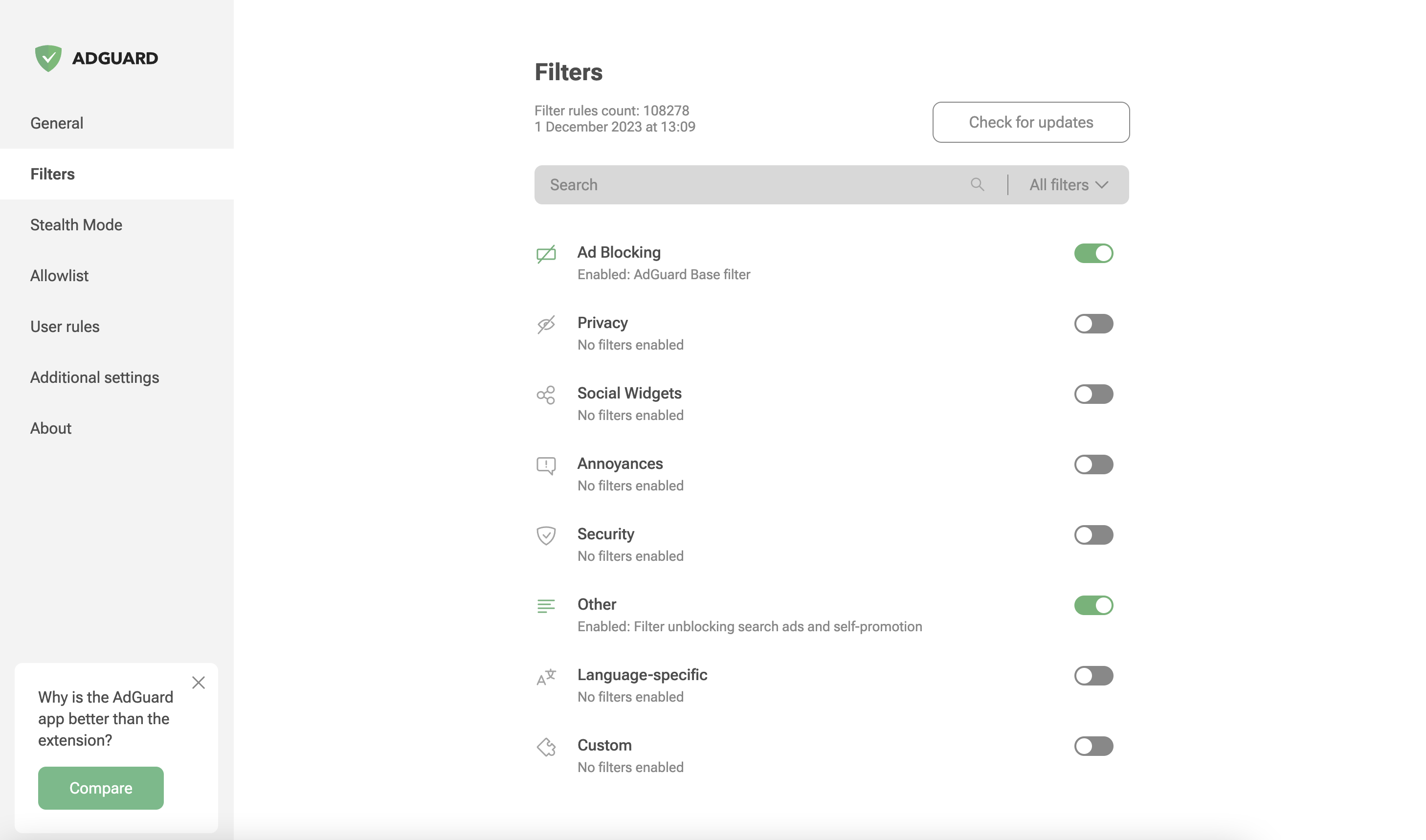
AdGuard Browser Extension is a powerful and optimized browser extension built to eliminate intrusive advertisements, protect users from tracking technologies, and provide a cleaner browsing experience.
The extension uses advanced filtering technologies to block various types of ads, unwanted scripts, and distracting page elements. In addition to blocking visible advertising, AdGuard helps reduce online tracking attempts and limits the collection of information that can be used for creating detailed user profiles.
Unlike the full AdGuard applications available for Windows and macOS, the browser extension is completely free and open source. It provides essential ad blocking and privacy protection features directly inside your browser.
AdGuard Browser Extension respects user privacy: it does not collect personal information, monitor browsing history, or participate in advertising programs based on acceptable ads. The project is supported by AdGuard products and continues to focus on secure and private browsing.
Install the extension directly from the official Chrome Web Store.
Download and install AdGuard Browser Extension from the official Mozilla Add-ons website.
The extension is available through the official Opera Add-ons store.
AdGuard can be installed from the official Microsoft Store.
AdGuard is developed with the help of an active community of contributors. Users can support the project by improving translations, testing new features, reporting bugs, or sharing suggestions.
Every contribution helps improve AdGuard Browser Extension and makes privacy-focused browsing available to more users worldwide.
Users interested in helping with translations can find details about the AdGuard translation program here:
https://adguard.com/kb/miscellaneous/contribute/translate/program/
Preview and beta versions of AdGuard Browser Extension are available for users who want to test upcoming improvements and provide feedback.
More information is available on the official beta page:
Bug reports and feature requests can be submitted through the official GitHub repository:
https://github.com/AdguardTeam/AdguardBrowserExtension/issues
Note
Issues related specifically to filtering rules, missed advertisements, or incorrect blocking should be reported here: https://github.com/AdguardTeam/AdguardFilters
Additional ways to contribute to AdGuard development are described here:
https://adguard.com/contribute.html
After installing AdGuard Browser Extension from your browser store:
- Click the AdGuard icon in the browser toolbar to open the extension interface. Protection is enabled automatically with recommended filter lists.
- Manage protection status for each website using the main control switch.
- Open extension settings through the settings menu to configure advanced options.
- Use Assistant to manually select and block unwanted page elements.
The extension works immediately after installation and includes default settings suitable for most users.
AdGuard requires specific browser permissions to provide ad blocking, privacy protection, filtering, and customization features.
tabs— required for extension tab management and settings pageswebRequest— used for analyzing and filtering network requestscookies— enables cookie-related privacy features and tracker protectioncontextMenus— adds browser menu integrationstorage— saves preferences, filtering rules, and user settingsunlimitedStorage— allows storing extended filter databaseswebNavigation— controls script injection timingprivacy— provides access to browser privacy-related settings
<all_urls>— enables filtering and modifying website contentwebRequestBlocking— allows direct request blocking
host_permissions— grants access to website resources under Manifest V3userScripts— enables custom filtering scriptsscripting— injects required scripts into webpagesdeclarativeNetRequest— handles request filtering and modificationdeclarativeNetRequestFeedback— provides filtering activity information
Due to the transition from MV2 to MV3, filter updates are distributed through automated build workflows instead of direct remote updates.
The CI pipeline generates new extension builds containing updated @adguard/dnr-rulesets packages and refreshed static filtering rules.
Automated processes regularly retrieve new versions of the @adguard/dnr-rulesets package and include updated rules in extension releases.
Build schedules ensure that users receive the latest filtering improvements as quickly as possible.
Chrome Web Store publishing restrictions may prevent some filtering-related updates from being released through the "skip review" process.
Filtering scripts are generated during the build stage and stored in local_script_rules.js for compatibility with the scripting API.
Automated builds include:
- Unit testing.
- Translation validation.
- Code quality verification.
- Resource synchronization.
- Integration testing.
After successful checks, the extension package is prepared for publication.
AdGuard Browser Extension uses the following version structure:
major.minor.patch+autoBuildIncrementVersion.buildTag.dnrRulesetsVersion
- major.minor.patch — standard semantic version identifier.
- autoBuildIncrementVersion — automatically generated build number.
- buildTag — describes the build type or release stage.
- dnrRulesetsVersion — version of the DNR filtering rules package.
Example:
5.2.1+88.beta.20251014
Browser-compatible builds use:
major.minor.patch.autoBuildIncrementVersion
AdGuard Browser Extension supports both Manifest V2 (MV2) and Manifest V3 (MV3).
| Browser | Version |
|---|---|
| Chromium-based browsers MV2 | ✅ 106 |
| Chromium-based browsers MV3 | ✅ 121 |
| Firefox | ✅ 78 |
| Firefox Mobile | ✅ 113 |
| Opera | ✅ 67 |
| Opera MV3 | ✅ 107 |
| Edge Chromium | ✅ 80 |
| Edge Legacy | ❌ |
- Development — development setup and workflow information
- Changelog — release history and updates
- LLM agent rules — guidelines for AI coding assistants