
The scaffold every Severino repo begins from. Lean enough to become any kind of project, but it ships with the standing cornerstones already wired: the Cordon emit-once command-surface contract, a green-gating CI, automated releases (release-please), the branch→PR→review→merge workflow, and one command that applies branch protection + repo security.
It is not a generator. It's a small, opinionated tree you copy and prune —
and the parts that would otherwise drift (the contract JSON, the describe.sh
machinery) are sourced from your toolchain, not vendored.
Quickest path: click Use this template on GitHub for a fresh repo with clean history. Or copy the tree locally and prune:
No manual cordon setup needed — scripts/check.sh resolves the engine from a
local cordon checkout, the repo's pinned cordon-spec devDependency, or the
published npm package via npx — in that order. A fresh machine runs the gate
with no download step and nothing written to ~/.zshrc.
cp -R "$PROJECTS_HOME/cordon-starter" "$PROJECTS_HOME/<repo>"
cd "$PROJECTS_HOME/<repo>"
rm -rf .git && git init -b main          # fresh history
scripts/setup-hooks.sh                    # local guardrails + commit template — works offline

# make it yours — keep ONE emitter track, prune the other
#   bash repo:  mv bin/example-tool bin/<repo>   ; rm bin/example-node contract/example-node.json
#   node repo:  mv bin/example-node bin/<repo>   ; rm bin/example-tool contract/example-tool.json
mv bin/example-tool bin/<repo>           # then rewrite its describe_spec / typed spec
$EDITOR AGENTS.md README.md              # delete what you don't need
rm -f contract/example-*.json            # drop the unused track's golden(s)

bin/<repo> --describe > contract/<repo>.json   # generate the golden contract (either track)
scripts/check.sh                          # shellcheck + drift + conformance

git add -A && git commit -m "Initial commit"
gh repo create joeseverino/<repo> --private --source=. --push
scripts/setup-governance.sh               # protect main + security settings
From here on: git fetch origin && git checkout -b <feature> origin/main, never
commit to main. See AGENTS.md.
| path | what it is |
|---|---|
AGENTS.md (+ CLAUDE.md symlink) |
the cornerstone playbook — read first |
bin/example-tool |
the bash track: a runnable Cordon-emitting tool; copy its describe_spec() (declare-a-DSL) |
bin/example-node + package.json |
the Node track: a one-file emitter that derives the surface from package.json scripts (via cordon's emitters/node) and declares only each command's blast radius; copy both for a Node/TS repo |
contract/example-tool.json, contract/example-node.json |
the committed golden contracts (emitted, never hand-edited) |
.github/workflows/ci.yml |
three lines calling cordon's reusable gate — the required cordon / gate check |
.github/workflows/release.yml |
three lines calling cordon's reusable release — the cordon / release check; cuts versions + GitHub Releases via release-please |
version.txt |
the version source for the default simple release-type; bump-managed by release-please |
scripts/try.sh |
smoke test — run it to watch the contract work end to end |
scripts/check.sh |
the gate — the identical wrapper every cordon repo ships; runs cordon's checks engine over cordon.checks.json. Pre-push, CI, and you all run it (--json for AI) |
scripts/_lib.sh |
in-repo presentation (palette + banner/step/run); sourced by try.sh, no external dep |
scripts/gen-readme.mjs |
renders the README CLI reference from contract/*.json — the README is a render of the contract (zero deps, drift-gated) |
.githooks/ + scripts/setup-hooks.sh |
local guardrails: pre-commit blocks main, commit-msg blocks AI attribution, pre-push runs the gate, and it wires commit.template |
scripts/setup-governance.sh |
GitHub-side branch protection (required cordon / gate, enforce_admins) + security via gh api |
.github/dependabot.yml |
keeps pinned Actions current; uncomment your language ecosystem (pip/npm) |
.editorconfig |
shared editor defaults (LF, final newline, 4-space / 2 for web) |
.gitmessage |
commit template — solo-authored guidance (wired by setup-hooks.sh) |
docs/CORNERSTONES.md |
the full checklist, one line per standard |
optional/base.css |
design-token seed from jseverino.com — opt in for frontends |
A tool declares its surface once in describe_spec(). The human -h text and
the machine --describe JSON are two pure renders of that one declaration, so
they can't disagree. Every command carries an effect
(read < local_write < vault_write < remote_write < deploy) so an agent can
risk-gate before it acts. The canonical emitter lives at
"$TOOLS_HOME/lib/describe.sh" — this starter sources it, never copies it.
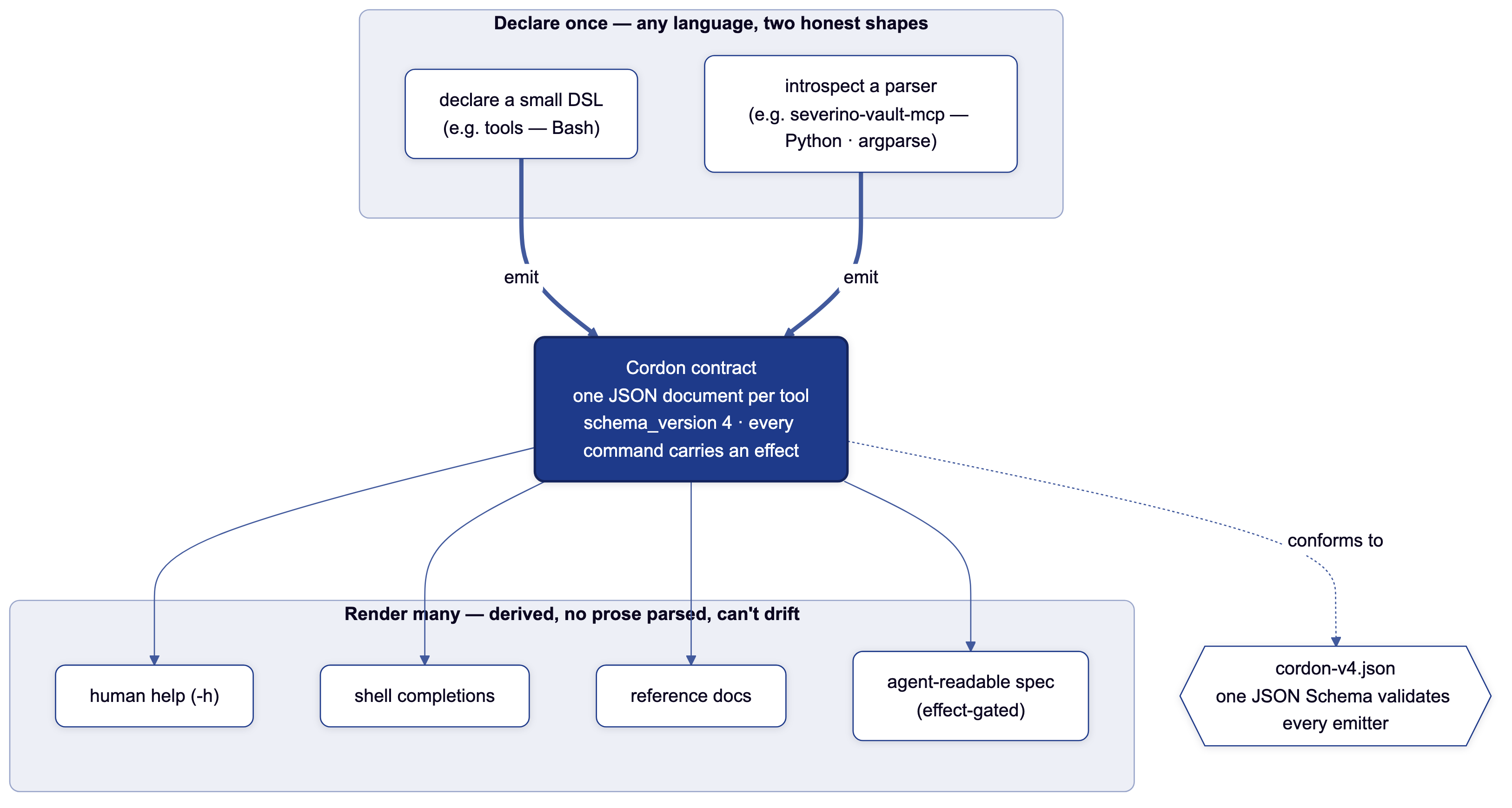
Diagram source: cordon / docs/diagrams/emit-once.mmd,
pre-rendered with diagram.
Full standard: jseverino.com/schemas/cordon-v4.json
and the cordon spec repo.
The block below is rendered from contract/*.json by scripts/gen-readme.mjs —
the README's command surface is a render of the contract, not a hand-kept copy.
The gate runs gen-readme.mjs --check, so editing it by hand (or letting it drift
from the tool) fails CI. This is the "render many" idea applied to the README
itself; every repo derived from the starter inherits it.
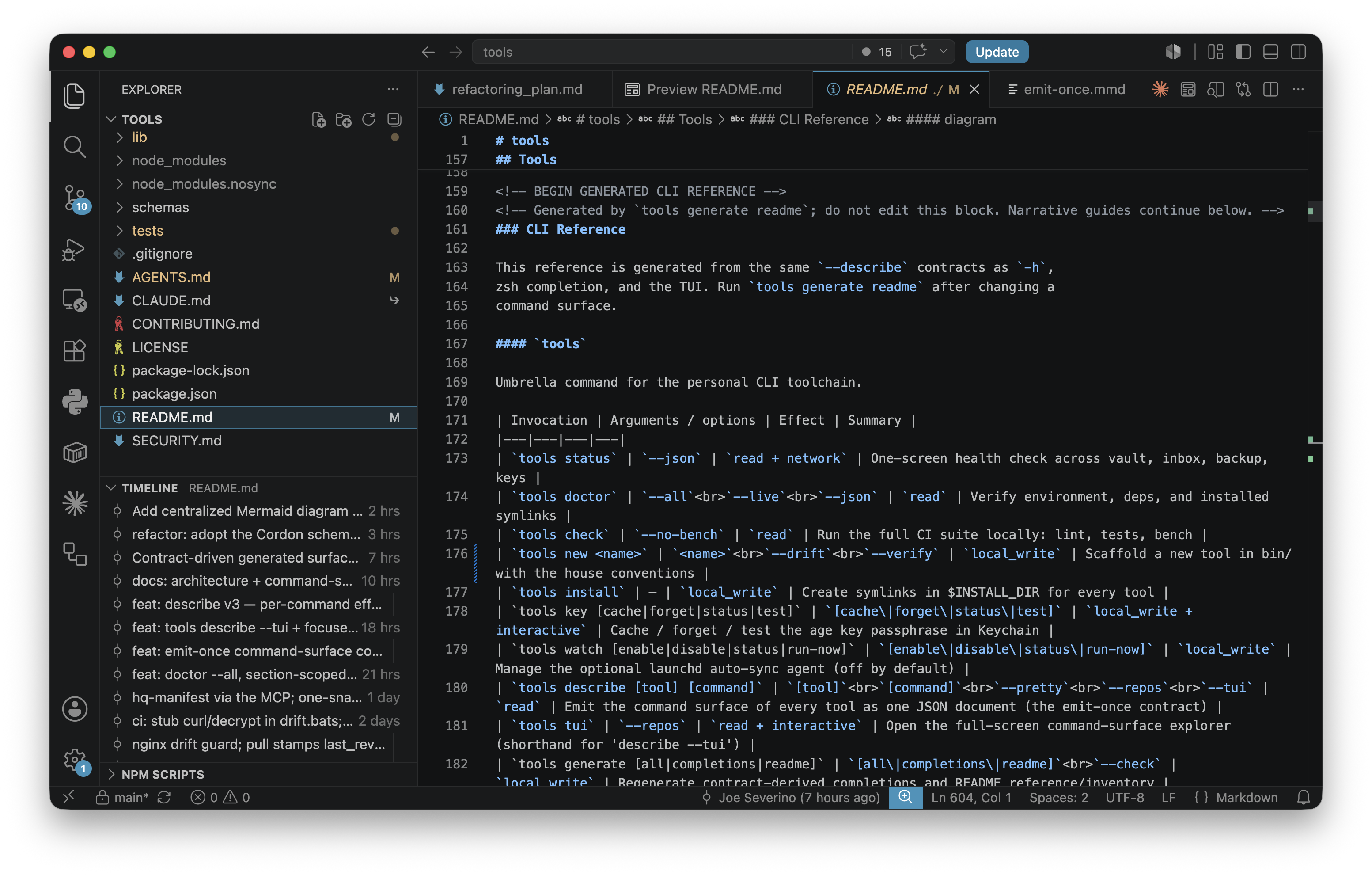
"Render many" made concrete: one Cordon contract rendered as a generated
README command reference — exactly what scripts/gen-readme.mjs produces below.
Source: cordon / docs/images/diagram-generated-readme.png.

effect: read
Replace me: one line on what this tool does.
Options
| flag | value | required | help |
|---|---|---|---|
-n, --dry-run |
no | no | Show what would happen; write nothing |
Arguments
| arg | required | help |
|---|---|---|
name |
yes | The thing to act on |
Examples
example-tool widget— acts on 'widget'example-tool -n widget— dry run
effect: read
Replace me: one line on what this repo does.
Commands
| command | effect | summary |
|---|---|---|
build |
local_write |
|
deploy |
deploy |
MIT © Joe Severino