Your repository's right hand — know what's risky before it merges.


"Know your repository's health before a bad commit breaks it."
RepoIntel is an MCP (Model Context Protocol) server that scans local Git repositories and surfaces risky commits, contributor patterns, and repo-wide health metrics — entirely offline, with zero setup.
It's built for two moments that matter most: reviewing a PR before you merge it, and inheriting a codebase you didn't write. Built on NitroStack, it exposes all findings as MCP tools so any AI assistant can query your repo's risk profile directly.
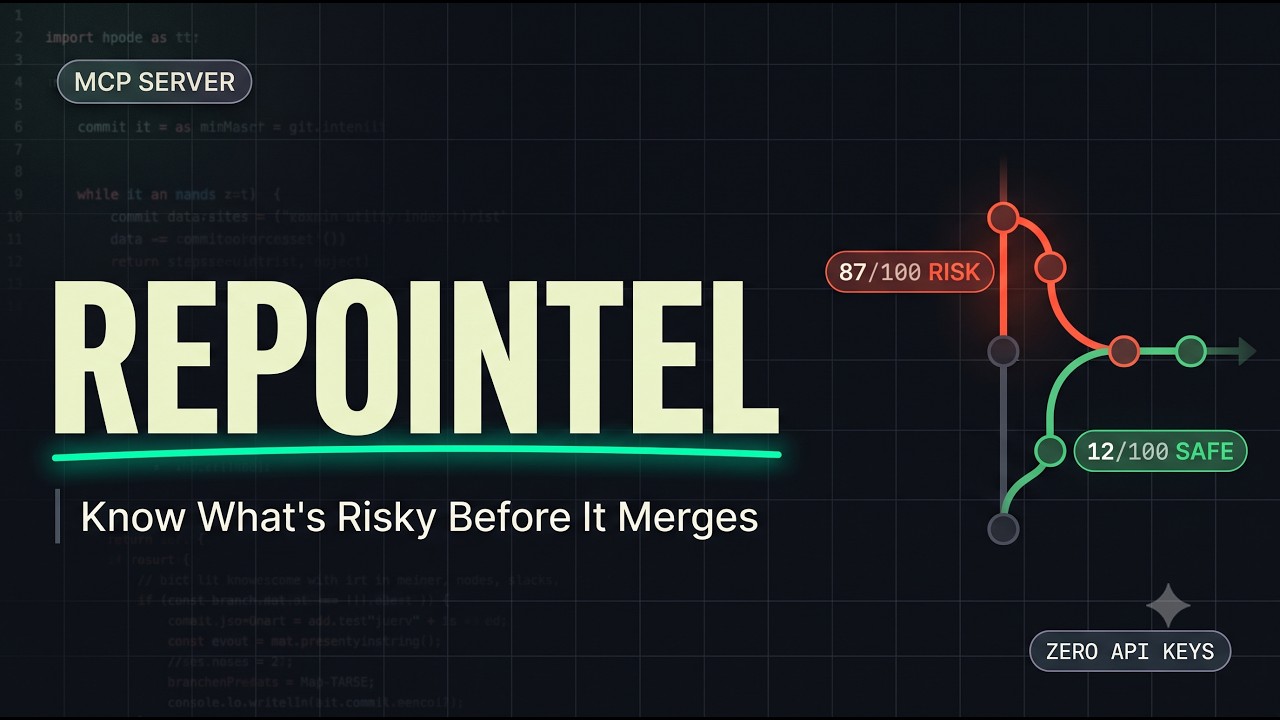
Most code analysis tools force you to upload source to the cloud, pay for a SaaS subscription, or wait minutes for a scan. Git Risk Analyzer does none of that.
- ✅ 100% offline — your code and git history never leave your machine
- ✅ Deep Git integration — analyzes real commit history and diff statistics, not just metadata
- ✅ Instant results — processes thousands of commits in seconds
- ✅ AI-native — designed for MCP, works with any AI assistant
🏢 Maintainers — your right hand for triage and review This is where the tool earns its keep. Maintainers can't manually review every incoming PR line by line — Git Risk Analyzer tells you where to look first.
- Score incoming PRs before reviewing them, so you know which ones need a close read
- Run
compare-branchesas a pre-merge gate — catch a risky feature branch before it lands onmain - Spot bus-factor risk: who's the only person touching a critical file
- Decide who gets merge rights based on real contribution history, not gut feel
💼 Professional developers
- Pre-commit health checks before opening a PR yourself
- Onboard faster on an unfamiliar codebase by seeing contributor patterns and hotspots
- Catch hardcoded secrets or risky file changes (
.env, config, migrations) before they ship
🎓 Students & learners
- Understand how commit habits affect repository health
- Catch risky changes before submitting an assignment
Tool: repository-health-score
Scans the full repository history and returns:
- Overall health status (excellent / good / fair / poor)
- Total commits and contributors
- Most modified files (hotspots)
- Recent activity and actionable recommendations
Tool: score-commit
Analyzes a single commit and returns a risk score (0–100) based on:
- Message quality — penalizes short or unclear commit messages
- Diff size — penalizes unusually large changesets
- Sensitive files — penalizes changes to
.env,package.json, migrations, and config files
Pass verbose: true for a human-readable summary with reasoning behind the score.
Tool: contributor-stats
Deep insight into individual contributors, or a full team ranking:
- Total commits and average risk score per author
- High-risk commits authored
- Most frequently modified files by author
sortBy: riskranks all contributors by average risk score
Tool: list-risky-commits
Filters repository history down to the commits that matter:
- Configurable risk threshold
- Returns matching commits ranked by score
Tool: generate-risk-report
One-shot aggregate report across the whole repository:
- Highlights the top 10 highest-risk commits
- Built for sprint retrospectives and hand-off documentation
Tool: compare-branches
The pre-merge gate. Compares risk metrics between two branches (e.g. feature/x vs main):
- Flags whether a branch is introducing excessive risk before you approve the merge
Tool: analyze-pr
Instantly analyze any public GitHub Pull Request without needing GitHub API keys:
- Pass a GitHub PR URL (e.g.,
https://github.com/owner/repo/pull/123) - Automatically clones the repository and fetches the PR branch natively
- Compares against the default branch and generates a risk score and summary
"Should I merge this PR right now?"
Run compare-branches on the PR branch vs main before approving — see the risk delta at a glance.
"I'm inheriting a legacy codebase — where do I start?"
Run repository-health-score — see hotspots and overall health in one call.
"Who are my riskiest contributors this quarter?"
Run contributor-stats with sortBy: risk — get a ranked list to guide review priorities, not blame.
"Did this commit introduce something dangerous?"
Run score-commit with verbose: true — catch hardcoded keys or oversized refactors in sensitive files.
"My team needs a risk report for the sprint."
Run generate-risk-report — a clean, professional summary of the riskiest changes.
| Tool | Module | Input | Output |
|---|---|---|---|
connect-repository |
repository | { repo_path } |
Connection status and basic repo info |
repository-health-score |
repository | { repo_path? } |
Full health score, hotspots, recommendations |
score-commit |
scanner | { commit_hash, repo_path?, verbose? } |
Detailed risk score and summary |
fetch-recent-commits |
scanner | { limit?, repo_path? } |
Array of recent commits with diff stats |
list-risky-commits |
reporter | { threshold?, repo_path? } |
Commits exceeding the risk threshold |
generate-risk-report |
reporter | { repo_path? } |
Comprehensive risk report |
contributor-stats |
contributors | { author?, repo_path?, sortBy?, limit? } |
Ranked contributor stats and high-risk commits |
compare-branches |
repository | { base_branch, target_branch, repo_path? } |
Risk comparison between two branches |
analyze-pr |
repository | { pr_url } |
Risk analysis of a remote GitHub Pull Request |
Note: All tools that accept a
repo_pathcan now seamlessly accept remote GitHub URLs as well. The server will transparently clone and cache the repository locally to perform the analysis!
RepoIntel uses native local Git execution (spawnSync) to interface directly with your repository:
- No external API calls — entirely local and fast
- Accurate diffing — uses raw
git logoutput for precise addition/deletion counts - Fixture fallback — falls back to mock data (
fixtures/commits.json) for testing when no repository path is provided
# Install dependencies
npm install

# Development mode (STDIO transport)
npm run dev

# Production build
npm run build

# Production start
npm startTransport is selected automatically based on NODE_ENV:
- Development (
NODE_ENV=development): STDIO only - Production (
NODE_ENV=production): Dual transport (STDIO + HTTP SSE)
Environment variables are loaded from .env via dotenv.
src/
├── index.ts                       # Entry point
├── app.module.ts                  # Root MCP module
├── modules/
│   ├── scanner/                   # Fetch commits, score individual commits
│   ├── reporter/                  # Generate reports, list risky commits
│   ├── repository/                # Repository health, connection, branch comparison
│   └── contributors/              # Contributor stats and risk ranking
├── services/
│   ├── git.service.ts             # Git operations & CLI execution
│   └── risk-scorer.service.ts     # Core risk scoring logic
└── health/
    └── system.health.ts           # System health check
@nitrostack/core— MCP framework with decorators and DI@nitrostack/cli— Build toolingtypescript— Strong typingzod— Input schema validation@nitrostack/widgets— Widget SDK for interactive views
- Zero network calls — everything runs locally
- No code upload — your repository never leaves your machine
- No API keys — no external services, no rate limits
- No telemetry — we don't track what you analyze
Built for maintainers who'd rather catch risk before it merges.