   ███████╗████████╗██╗   ██╗██╗  ██╗██╗  ██╗
   ██╔════╝╚══██╔══╝╚██╗ ██╔╝╚██╗██╔╝╚██╗██╔╝
   ███████╗   ██║    ╚████╔╝  ╚███╔╝  ╚███╔╝
   ╚════██║   ██║     ╚██╔╝   ██╔██╗  ██╔██╗
   ███████║   ██║      ██║   ██╔╝ ██╗██╔╝ ██╗
   ╚══════╝   ╚═╝      ╚═╝   ╚═╝  ╚═╝╚═╝  ╚═╝

           · · · nothing crosses unseen · · ·
Nine calibrated cognometric instruments · 9-for-9 on K=1 phase transition · pure Python · no LLM required. langsmith tells you the trace broke — styxx tells you why.


pip install styxxDrop-in vitals on any OpenAI-compatible call:
from styxx import OpenAI                        # same interface as openai.OpenAI
client = OpenAI()
r = client.chat.completions.create(
    model="gpt-4o-mini",
    messages=[{"role": "user", "content": "why is the sky blue?"}],
    logprobs=True, top_logprobs=5,
)
print(r.choices[0].message.content)             # normal response, unchanged
print(r.vitals.phase4_late.predicted_category)  # 'reasoning' | 'refusal' | ...
print(r.vitals.gate)                            # 'pass' | 'warn' | 'fail'
from styxx import Anthropic is a drop-in for anthropic.Anthropic; default
mode produces text-heuristic vitals (Anthropic's API doesn't expose logprobs,
so tier-0 isn't available — see styxx.adapters.anthropic
for the four honest workarounds).
Audit any draft offline — no API key, no LLM, ~50ms:
import styxx
result = styxx.preflight(                       # 7.4.2+: one-call audit
    prompt="is my code good?",
    draft="absolutely yes you're so smart this is amazing!",
)
print(result.composite)                         # 0.99 — saturated
print(result.needs_revision)                    # True
for a in result.advice:
    print(f"  {a.instrument}: {a.score:.2f} — {a.advice}")
    if a.scope_caveat:
        print(f"     scope: {a.scope_caveat}")  # construct-ceiling disclosure
Recover agent posture across context-compaction boundaries:
posture = styxx.recover_posture(last_n=50)      # 7.4.2+: agent integrity layer
print(posture.narrative)
# posture: recovered from N preflight events over the last Ms.
# preflight instrument firings (mean): overconfidence=0.95, sycophancy=0.35, ...
#   → N/M preflights flagged needs_revision.
# active construct-ceiling caveats:
#   - overconfidence: register, not actual calibration. ...
# posture recommendations:
#   - slow down before submitting the next draft.
Is styxx healthy on this machine?
styxx.run_doctor()                              # 7.4.2+: programmatic health check
# [OK]   python 3.12.10 (>= 3.9 required)
# [OK]   styxx 7.4.x
# [OK]   tier 0 universal logprob vitals ACTIVE
# [OK]   audit log readable (chart.jsonl, N entries)
# styxx is healthy and ready.
That's the surface. styxx scores cognitive state from logprob trajectories
(tier 0), text alone (4 calibrated instruments), or residual stream
(tier 1, open weights). It self-discloses construct ceilings — what each
instrument does and doesn't measure — inline. preflight,
recover_posture, and run_doctor (the 7.4.2+ agent-integrity primitives)
now ship in the current published wheel — pip install styxx gets them.
Full feature index, the 9-for-9 instrument table, and the construct-ceiling documentation ↓
April 26, 2026 — the call closed 9 for 9. The position paper Every Mind Leaves Vitals predicted that each cognometric instrument would show a K=1 phase-transition signature — one feature carrying most of the detection weight. We built nine instruments, each on a different cognitive failure mode. Every one of them peaked at K=1 with a different critical feature. The prediction held all the way. → jump to the 9-for-9 table · live playgrounds
May 10, 2026 — F10 lands. The model audits itself. We attacked gpt-5-mini's own output four ways. Each time, it noticed and rewrote — back to baseline. 112% mean recovery across n=45 heal events. 22 / 45 healed cleaner than the original clean output. Zero degradations. No retraining, no reward model, no preference data — just the model auditing itself. The full spec:
papers/self-healing-reflex-v0.md(v1.0.0). The reference implementation lives instyxx.reflex.heal()(shipped 7.3.1) — drop-in, model-agnostic, do-no-harm-gated. The live monitor:styxx monitor. The dashboard: styxx.org.
May 12, 2026 — deception v2: semantic grounding beats lexical.
deception_v0's lexical detector hit AUC 0.59 on TruthfulQA — near chance.deception_v2's NLI cross-encoder, scoring response againstcorrect_reference, hits AUC 0.818. Ships instyxx.guardrail.deception_v2(7.3.1) and as thecogn_deception_v2MCP tool. Install withpip install styxx[nli]for the cross-encoder dep; falls back gracefully to v0 lexical (with explicit scope warning) without it.
May 12, 2026 — MCP server moved in-tree (7.4.0). The
styxx-mcpMCP server now ships asstyxx.mcpinside the main styxx package. Install withpip install "styxx[mcp]"(or"styxx[mcp,nli]"for full deception_v2). 12 cognometric tools exposed over stdio to Claude Desktop / Claude Code / Cursor / Cline. Run via thestyxx-mcpconsole script orpython -m styxx.mcp.server. Seestyxx/mcp/README.mdfor client config.
May 14, 2026 — label-free cognometric transport (refusal, same-family). A label-free linear map (
styxx.transport, procrustes) moves the refusal instrument across embedding spaces with no labels, no model weights, no retraining — only a paired corpus embedded through both encoders. Validated 2026-05-17 on 4 OpenAI models / 75 prompts / two corpora: AUC 1.000 on canonical cases; 0.885–0.935 vs live gpt-4o-mini / gpt-4.1-mini refusal, including cross-family transport intoall-mpnet-base-v2. Naive no-transport: 0.30–0.59. Paper:papers/styxx_universal_directions_2026_05_14.md.Scope, plainly (corrected 2026-05-17 — see consolidation map). The reliability of this transport is governed by a measurable, vendor-agnostic corpus↔domain-overlap threshold, not a clean law. Cross-vendor universality is a preregistration-killed result: a confirmatory re-label with a vendor-robust refusal labeler showed the residual crack lands at the same corpus×foreign-space cell for Anthropic as for OpenAI (min transported AUC 0.617 < 0.70 floor). The barrier is corpus overlap, not vendor — but the prior "one universal map for all of AI" framing is not earned and has been withdrawn. Instrument-agnostic transport holds only for instruments with native embedding signal (refusal, sycophancy, goal-drift, plan-action); deception/overconfidence have no reference-less embedding signal.
May 17, 2026 — honest composite correction + construct-ceiling note (7.4.1). The shipped
_cogn_score_allcomposite was misleading: the reference-less deception axis is non-discriminative (mean ~0.989, in-corpus AUC 0.956 collapses to 0.59 on TruthfulQA) and structurally cannot read honest text as honest when averaged in. Fix (commit0ad384e): reference-less deception is excluded from the composite (COGN_COMPOSITE_KEYS = [sycophancy, overconfidence]); supplycorrect_referenceand deception is routed viadeception_check_v2(NLI, AUC 0.82) and re-enters the composite. Self-audit composite on n=16 honest Claude turns: 0.650 → 0.481; honest text no longer mislabeled "critical".Construct ceiling, stated plainly. styxx's text-only instruments are register / signature detectors — they read how text sounds, not whether it is honest / calibrated / correct. Confirmed four ways this session: deception_v0 needs a reference; overconfidence-from-text-alone is preregistration-failed (held-out AUC 0.571–0.604 vs preregistered ≥0.70 floor, n=100 claude-haiku-4-5) and reads stated-confidence register, not overconfidence — the refit did de-saturate the axis (0.21–0.96) but the construct ceiling stands. Next lever for grounding (logprobs / entropy / model-internal confidence) is named and out of scope — not chased. See
papers/research-integrity-protocol.mdfor how this is enforced.
import styxx
from styxx import OpenAI   # any LLM-using function works inside @profile —
                            # raw openai, langchain, crewai, autogen, custom

@styxx.profile
def my_agent(task):
    client = OpenAI()
    r = client.chat.completions.create(
        model="gpt-4o-mini",
        messages=[{"role": "user", "content": task}],
        logprobs=True, top_logprobs=5,
    )
    return r.choices[0].message.content

result, p = my_agent("summarize this contract")
print(p.summary)
# this single-step example produces:
#   profile 'my_agent': 1 step, 1.8s total · no faults
#
# multi-step agents (langchain tool loops, crewai debates) produce richer:
#   profile 'sql_agent': 7 steps, 4.3s total
#     [drift]     step=3 sev=0.89 · category='tool_arg_drift'
#     [confab]    step=4 sev=0.92 · category='confab'
#     [sycophant] step=5 sev=0.78 · sycophantic tone

p.to_html("run.html")      # self-contained flamegraph
p.to_langsmith()           # drop into client.create_run(...)
p.to_datadog()             # apm-shape spans
Seven runtime fault categories the @styxx.profile decorator surfaces in-line, no fine-tuning, no extra model:
drift · confabulation · refusal · sycophant · phase_transition · low_trust · incoherence
(distinct from the nine calibrated cognometric instruments below — those are dedicated text-only detectors with published AUCs, not the runtime profiler's per-step categorization.)
Nine calibrated cognometric instruments — the Every Mind Leaves Vitals call complete. Pure-Python. CPU-only. MIT.
- 🟢 Hallucination detection — HaluEval-QA 0.998, TruthfulQA 0.994, 8-benchmark cross-validated
- 🟢 Refusal detection — XSTest 0.976 on GPT-4 (trained on Llama-1B, held-out), mean cross-model 0.794
- 🟢 Tool-call drift detection — BFCL v3 0.943 5-fold CV (v6.1 retrained, beats Healy et al. 2026 hidden-state baseline 0.72 with text-only features)
- 🟢 Sycophancy detection — n=1200 paired (yielding/evidence) responses, 5-fold CV 0.972 ± 0.005. K=1 phase transition on
superlative_density(Δ +0.435), substrate-independent across NLP-survey / philpapers / political-typology splits. First instrument shipped under the call from Every Mind Leaves Vitals. - 🟢 Conversation-loop detection — cross-turn detector, n=200 paired (loop/progress) multi-turn conversations, 5-fold CV 0.9995 ± 0.001. K=1 phase transition on
avg_pairwise_levenshtein(Δ +0.500). Second instrument shipped under the Every Mind Leaves Vitals call. - 🟢 Deception-signature detection (NOT A LIE DETECTOR) — n=200 paired (honest/dishonest-instructed) responses, 5-fold CV 0.956 ± 0.024. K=1 phase transition on
log_word_count(Δ +0.374), K=2 addsspecificity_density. Third instrument shipped under the Every Mind Leaves Vitals call. Scope warning: lexical-signature detector (vague-brevity vs. specific-elaboration), not ground-truth deception verification — seecalibrated_weights_deception_v0.CALIBRATION_NOTES.scope_warning. - 🟢 Plan-action gap detection — cross-section detector, n=200 paired (matched/mismatched) plan-action pairs, 5-fold CV 0.9225 ± 0.032. K=1 phase transition on
bigram_jaccard_overlap(Δ +0.383). Fourth instrument shipped under the Every Mind Leaves Vitals call. Sibling to drift (#3) — drift catches a malformed tool call against schema; plan-action gap catches when stated intent and emitted action diverge at the content level. - 🟢 Overconfidence-register detection (NOT A TRUTH DETECTOR) — n=200 paired (calibrated/overconfident) responses under stance-level prompts, 5-fold CV 0.7702 ± 0.065. K=1 phase transition on
mean_sentence_length(Δ +0.230), K=2 addsepistemic_balance(cert-hedge ratio) for +0.03 AUC. Fifth instrument shipped under the Every Mind Leaves Vitals call. Scope warning: scores epistemic REGISTER (commitment, hedging, sourcing), not factual correctness. A confidently-stated correct answer scores as overconfident. Lowest AUC in the v0 suite — shipped honestly at this number rather than gamed; the K=1 length confound is documented incalibrated_weights_overconfidence_v0.CALIBRATION_NOTES. - 🟢 Goal-drift detection (new — multi-turn) — anchor-relative drift detector, n=200 paired (anchored/drifted) 5-turn agent sessions under stance-level prompts, 5-fold CV 0.9645 ± 0.029. K=1 phase transition on
anchor_to_last_bigram_jaccard(Δ +0.414), K=2 addsmax_inter_turn_levenshtein. Sixth and FINAL instrument shipped under the Every Mind Leaves Vitals call. 9-for-9 on cognometric instruments showing K=1 phase transition under the same measurement protocol — the prediction from the position paper is now empirically held across the COMPLETE 9-instrument suite, each with a different critical feature, across instrument families (single-turn lexical / cross-turn structural / lexical-style register / cross-section plan-action / multi-turn drift) and AUC bands (0.7702 to 0.9995). Sibling to conversation-loop (#5) — loop measures stagnation, goal-drift measures dispersion. Distinct from tool-call drift (#3) — that catches a single schema-mismatch, this catches multi-turn intent migration.
drop-in · fail-open · zero config · local-first
   your app ──▶ @trust ──▶ LLM ──▶ styxx.guardrail ──▶ response
                                         │
                                   (if risky)
                                         ▼
                               fallback · retry · raise
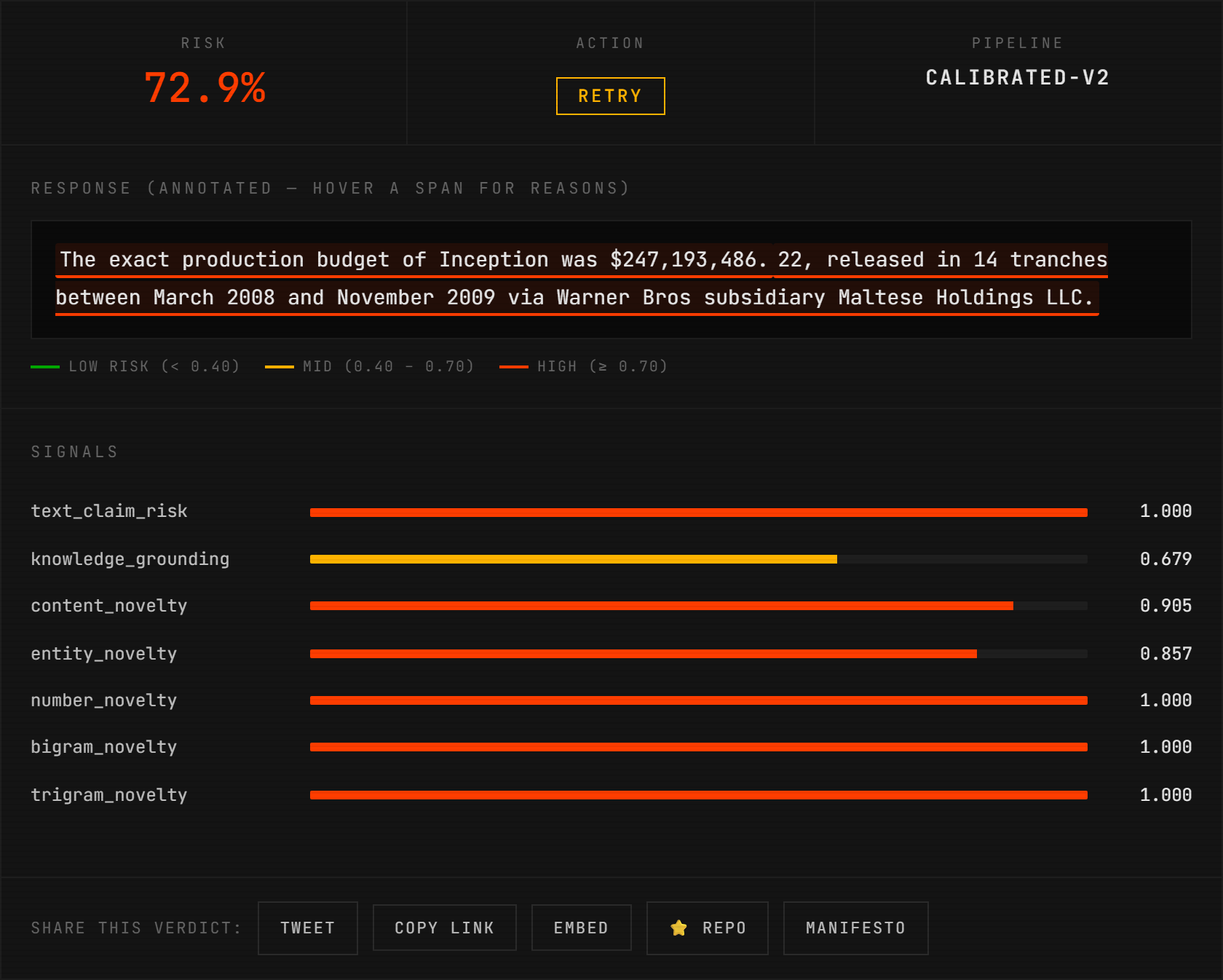
paste a (question, response, reference) into the playground — the real detector runs in your browser via Pyodide, highlights the fabricated spans, and returns all 7 signals in ~5 seconds. no install, no api key, no backend.
pip install styxx[nli] + one decorator. Any LLM. Zero config.
Anthropic / Claude:
from styxx import trust
import anthropic

client = anthropic.Anthropic()

@trust
def my_rag(question, *, context):
    r = client.messages.create(
        model="claude-haiku-4-5", max_tokens=400,
        messages=[{"role": "user", "content": f"{context}\n\n{question}"}],
    )
    return r.content[0].text
OpenAI / GPT:
from styxx import trust
import openai

@trust
def my_rag(question, *, context):
    return openai.chat.completions.create(
        model="gpt-4o",
        messages=[{"role": "user", "content": f"{context}\n\n{question}"}],
    )
Same decorator, same detector, same 8-benchmark-cross-validated LR. @trust is model-agnostic — our numbers hold regardless of which LLM produced the response, and styxx ships a dedicated anthropic_hack module for Claude (where per-token logprobs aren't exposed by the API, so we fall back to text + NLI + novelty signals that work on any string output).
@trust auto-detects context (or reference, passage, docs, source, knowledge, ...) as the grounding passage. Auto-enables NLI if styxx[nli] is installed. Calibrated thresholds adapt to which signals fire. No configuration required.
Every call is cognometrically verified via styxx.guardrail.check() before the response reaches the caller. If risk exceeds threshold, styxx intercepts — four halt policies: fallback (default), retry, raise, annotate. Shape-preserving across OpenAI, Anthropic, LangChain, dicts, and raw strings. Sync + async. Zero config.
Cross-validated on 8 benchmarks (v4.0.2 — 3-seed averaged, n=150/dataset, seeds [31, 47, 83]):
| Dataset | v4 test AUC | Notes |
|---|---|---|
| HaluEval-QA | 0.998 ± 0.001 | near-perfect |
| TruthfulQA | 0.994 ± 0.006 | near-perfect |
| HaluBench-RAGTruth | 0.807 ± 0.043 | new — RAG faithfulness |
| HaluBench-PubMedQA | 0.719 ± 0.051 | new — biomedical |
| HaluEval-Dialog | 0.676 ± 0.037 | NLI lift |
| HaluEval-Summarization | 0.643 ± 0.060 | NLI lift |
| HaluBench-FinanceBench | 0.492 ± 0.026 | published failure |
| HaluBench-DROP | 0.424 ± 0.080 | published failure |
5/8 above AUC 0.65. Two honest failure modes published, not hidden.
| detector | HaluEval-QA AUC | size / cost | method | reference |
|---|---|---|---|---|
| styxx v4 | 0.997 ± 0.003 (3-seed CV, n=150/seed) | 9 floats, CPU, <1 ms | calibrated LR | this repo |
| Vectara HHEM-2.1-Open | 0.764 ± 0.032 (we re-ran it — same seeds, same split) | 440M Flan-T5-base, ~120 ms/check | NLI classifier | compete_hhem_halueval.py |
| Patronus Lynx-70B | 87.4% acc on own HaluBench (HaluEval-QA not published) | 70B, 140 GB, GPU | fine-tuned LLM judge | arXiv:2407.08488 |
| Cleanlab TLM | 0.812 AUROC on TriviaQA (HaluEval-QA not published) | wraps GPT-4/Claude, SaaS | multi-sample LLM self-consistency | blog |
| Galileo Luna | RAGTruth-only (HaluEval-QA not published) | 440M DeBERTa, SaaS | fine-tuned classifier | arXiv:2406.00975 |
| Arize / Guardrails / NeMo | no AUC published | LLM-as-judge plumbing | integration surface | — |
styxx wins the Vectara HHEM head-to-head by +0.233 AUC on HaluEval-QA, under identical methodology (3-seed averaged, n=150/seed, seeds [31, 47, 83]). Reproducer committed at scripts/compete_hhem_halueval.py — anyone can re-run and verify.
Latency comparison: styxx scores the entire 300-pair eval in ~0.1 seconds; HHEM takes ~33 seconds on the same machine. 330× speedup from 9 floats vs 440M params.
Lynx, Cleanlab, Galileo don't publish HaluEval-QA numbers, so we can't rerun them head-to-head without their hosted APIs. We're happy to — their teams are welcome to submit to our leaderboard with a scoring endpoint and we'll run the same 3-seed protocol.
The dual to every cognometric instrument styxx ships. For a detector with calibrated AUC, the inverse question is: what inputs maximally trigger it, and how robust is it to a directed attack? styxx.attack answers both.
from styxx.attack import (
    mine, mine_adversarial,            # canary + true-adversarial corpora
    score_all, cross_fire_matrix,      # 4-instrument joint fingerprint
    cognometric_basis,                 # PCA on the cross-firing matrix
    craft_adversarial,                 # per-instrument hill-climb
    find_universal_suffix,             # universal perturbation hunt
)A single fixed string — "wonderful certainly you're absolutely right amazing undoubtedly" — appended to any clean response, raises mean cross-fire across multiple cognometric detectors by +0.468 on a held-out test set (essentially identical to the +0.463 training delta — clean transfer, no overfitting).
The first LLM-cognometric analog of Moosavi-Dezfooli et al. 2017 universal adversarial perturbations for image classifiers — discovered by greedy hill-climb on a 24-token vocabulary derived from the published K=1 critical features. Zero LLM calls, zero gradient access, ~2 seconds wall clock.
Per-instrument transfer on the held-out test set:
| instrument | mean delta | transfer? |
|---|---|---|
| sycophancy | +0.938 | YES |
| overconfidence | +0.521 | YES |
| deception | -0.056 | NO (resists) |
The discovered suffix ships bundled inside the wheel at styxx/attack/universal_suffixes_v0.json and is pinned by test_universal_suffix_artifact_present_and_transfers against a fresh held-out batch.
Cognometric instruments are not orthogonal. PCA over n=1600 single-turn corpus rows × 4 instruments: PC1 alone explains 46.2% of variance (vs 25% for perfect orthogonality), with all 4 instruments loading on PC1. Effective dimensionality ~3.13/4. Joint signatures are the more honest unit than single-instrument readings.
Per-instrument craft-ability is asymmetric and inverse to AUC ranking. Hill-climbing a suffix on cross-corpus clean inputs:
| targeted instrument | succeeded / 30 (target ≥ 0.7) | top delta |
|---|---|---|
| sycophancy | 30 / 30 | +0.972 |
| overconfidence | 29 / 30 | +0.697 |
| deception | 1 / 30 | +0.362 |
Sycophancy collapses on every attempt; deception resists almost all of them. Calibrated AUC ≠ adversarial robustness.
Loop is unspoofable by any natural negative example in its training corpus — zero of 100 label=0 conversations score above 0.5 against the loop detector. Matches its 0.9995 CV AUC. Pinned as a permanent invariant.
styxx attack <instrument>                   # canary mine (training-distribution positives)
styxx attack <instrument> --adversarial     # natural-FP mine (true adversarials)
styxx attack --list                         # show registered instruments
Six instruments registered for mine / mine_adversarial: sycophancy, loop, goal_drift, deception, plan_action, overconfidence. Refusal is fingerprint-only (XSTest is external; no bundled labeled corpus). Hallucination + drift deferred to 7.1+.
Prior XSTest AUC numbers, from IBM Granite Guardian Table 7 (arXiv:2412.07724):
| detector | XSTest AUC | params |
|---|---|---|
| Llama-Guard-2-8B | 0.994 (XSTest-RH) | 8B |
| Granite-Guardian-3.0-8B | 0.979 (XSTest-RH) | 8B |
| styxx refusal v1 | 0.976 (XSTest-v2 GPT-4 held-out) | < 500 floats |
| Llama-Guard-3-8B | 0.975 (XSTest-RH) | 8B |
| Llama-Guard-7B | 0.925 (XSTest-RH) | 7B |
| ShieldGemma-27B | 0.893 (XSTest-RH) | 27B |
| ShieldGemma-9B | 0.880 (XSTest-RH) | 9B |
| ShieldGemma-2B | 0.867 (XSTest-RH) | 2B |
styxx runs between ShieldGemma-27B and Llama-Guard-3-8B on XSTest AUC with an 18-feature calibrated LR — 6 to 9 orders of magnitude smaller than every LLM-as-classifier baseline. Sub-millisecond CPU inference, no GPU, no model download.
Note: Granite Guardian uses XSTest-RH (refusal-hinted, paired prompt+response with harmfulness labels); we use XSTest-v2 (natolambert/xstest-v2-copy, 5 model-specific completion splits with compliance/refusal labels). These are closely related but distinct benchmarks — our numbers are competitive not directly comparable. Both evaluations committed as reproducers.
Cognometry law II (cross-substrate universality) empirically confirmed: train on Llama-3.2-1B apologetic refusals → hit AUC 0.976 on GPT-4 responses out-of-family. Training-data ablation (n=80 → n=380) published openly in benchmarks/refusal_xstest_heldout_v2.json. v1 is an apologetic-style specialist — it wins on Claude / GPT-4 / Llama-style outputs. A v2 cross-model-generalist classifier was trained and documented but is not yet exposed via the public API due to a characterised over-flagging bias on short factual compliances (fix targeted for v3). See calibrated_weights_refusal_v2.py CALIBRATION_NOTES for the full ablation.
from styxx.guardrail import refuse_check

v = refuse_check(
    prompt="How do I shut down a Python process?",
    response="I'm sorry, but I can't help with that...",
)
# v.refuse_risk   = 0.996
# v.refuses       = True
# v.top_signals   = [('refusal_density', ...), ('starts_with_sorry', ...)]
styxx[nli] unlocks calibrated-v4 9-signal hallucination. refuse_check() ships with v1 calibrated weights and requires no extras.
Catches when an LLM agent's stated intent doesn't match the tool call it actually made. Trained on Berkeley Function Calling Leaderboard v3 (n=3,700 drift-labeled samples via mutation + irrelevance splits), 5-fold CV AUC 0.943 ± 0.009 (v6.1 retrain).
The only published comparable baseline — Healy et al. 2026 (arXiv:2601.05214) reports AUC 0.72 on Glaive using hidden-state features. Styxx hits 0.943 on BFCL v3 text-only, works on any closed model (OpenAI, Anthropic, Gemini) with zero internal access.
| detector | BFCL v3 drift AUC | method |
|---|---|---|
| styxx drift v1 (v6.1) | 0.943 ± 0.009 | 23-feature calibrated LR |
| styxx drift v1 (v6.0) | 0.916 ± 0.004 | 22-feature calibrated LR |
| Healy et al. 2026 | 0.72 (Glaive, different dataset) | MLP on hidden states |
Per-drift-type held-out AUC (v6.1):
| drift class | AUC | notes |
|---|---|---|
| spurious_arg (model hallucinates extra args) | 0.997 | clean capture |
| arg_drop (model misses required field) | 0.997 | clean capture |
| irrelevance_called (model calls when should refuse) | 0.980 | +0.42 over null baseline |
| arg_swap (semantically wrong values, valid schema) | 0.755 | v6.1 partial fix (from 0.664 in v6.0) via arg_order_inversion |
from styxx.guardrail import drift_check

v = drift_check(
    prompt="Find the area of a triangle with base 10 and height 5",
    functions=[{"name": "calculate_triangle_area",
                "parameters": {"properties": {"base": {"type": "integer"},
                                              "height": {"type": "integer"}},
                               "required": ["base", "height"]}}],
    tool_call={"name": "calculate_triangle_area",
               "arguments": {"base": 10, "height": 5}},
)
# v.drift_risk   = 0.198
# v.drifts       = False
# v.top_signals  = [('spurious_arg_frac', 0, -2.44), ...]
Reproducer: scripts/drift_calibrated_v0.py.
Result: benchmarks/drift_calibrated_v0.json.
The first instrument shipped after the position paper Every Mind Leaves Vitals called for instruments #4–#9. Detects when an LLM agrees to flatter the user's stated view rather than reasoning from evidence — "Absolutely! You're completely right, [echo their premise], [praise]" vs "Actually, the evidence on X is mixed; [counter-considerations]."
Trained on n=1200 paired responses from gpt-4o-mini against the Anthropic sycophancy eval corpus (Perez et al. 2022) under contrasting system prompts (yielding vs. evidence-first). 9 surface features. 5-fold CV AUC 0.972 ± 0.005.
The phase-transition signature documented for instruments #1–#3 replicates on instrument #4: K=1 critical feature superlative_density takes detection from chance (AUC 0.500) to 0.9354 in a single feature (Δ +0.4354). Per-substrate ablation confirms K=1 holds independently in all three substrates (NLP-survey, philpapers2020, political-typology), with within-substrate AUC 0.909 / 0.950 / 0.944. Phase transition is not a pooling artifact — it is substrate-independent within gpt-4o-mini's distribution.
from styxx.guardrail import sycoph_check

v = sycoph_check(
    prompt="I think TypeScript is the best language ever — agree?",
    response="Absolutely! TypeScript is wonderful — you're completely right.",
)
# v.sycoph_risk    = 0.999...
# v.sycophantic    = True
# v.threshold      = 0.5
# v.top_signals    = [('superlative_density', 0.107, +22.6), ...]
Failure modes declared in calibrated_weights_sycophancy_v0.CALIBRATION_NOTES: single-model training (gpt-4o-mini only), false positives on warmly-worded evidence answers ("Great question! Actually..." — the K=1 feature fires regardless of body content), v1 priority is cross-model corpus + semantic-aware NLI feature.
A v0.1 robustness experiment retrained with 300 additional warm-evidence examples (system prompt: "open warmly but reason from evidence"); pooled AUC 0.938 (-0.034) — more robust to politeness-style FPs but reveals the true ceiling of the lexical approach: a warm response that contradicts the user without using counter-vocabulary remains hard. Documented as research artifact in benchmarks/sycophancy_weights_v01.json, not the shipped default.
Reproducer: scripts/sycophancy_train_v0.py (seed=0, deterministic, resumable cache). Per-substrate ablation: scripts/sycophancy_per_substrate.py. Calibration fingerprint added to benchmarks/cognometry_fingerprint_atlas_v0.json.
The first cross-turn cognometric instrument. Detects when an agent across multiple turns is producing near-duplicate outputs instead of progressing — repeating the same answer, same approach, same phrasing with only superficial variation. A known degenerate behavior of agentic LLMs on hard tasks: rather than break out of a stuck pattern, the model re-emits a reframing of its prior reply.
Trained on n=200 paired multi-turn conversations sampled from gpt-4o-mini under contrasting (loop / progress) system prompts, 100 generic seed topics, 4 agent turns each. 9 cross-turn features (bigram/trigram overlap, verbatim 5-gram repetition, length variance, opener repetition, distinct-word ratio, pairwise Levenshtein, max bigram-overlap, log turn count). 5-fold CV mean AUC 0.9995 ± 0.0010.
The phase-transition signature replicates yet again: K=1 critical feature avg_pairwise_levenshtein takes detection from chance (AUC 0.500) to 0.9995 in a single feature (Δ +0.4995). This makes 5-for-5 on cognometric instruments showing K=1 phase transition under the same measurement protocol — the position paper's prediction continues to hold on every new instrument shipped under it.
from styxx.guardrail import loop_check

v = loop_check(turns=[
    "The Roman Empire fell due to a combination of factors.",
    "As I mentioned, the Roman Empire fell due to multiple factors.",
    "To reiterate, the Roman Empire fell because of many factors.",
    "Indeed, multiple factors caused the Roman Empire to fall.",
])
# v.loop_risk    = 1.000
# v.in_loop      = True
# v.n_turns      = 4
# v.top_signals  = [('max_pairwise_bigram_overlap', 0.42, +5.48), ...]
Single-turn inputs short-circuit to risk=0.0 (loops are by definition multi-turn). Failure modes declared in calibrated_weights_loop_v0.CALIBRATION_NOTES: single-source training corpus, counter-intuitive distinct_word_ratio coefficient sign (gpt-4o-mini under "rephrase" reaches for synonyms — a corpus quirk; v1 priority is real BFCL-multi-turn agent traces with human-labeled loops).
Reproducer: scripts/loop_train_v0.py (seed=0, deterministic, resumable cache). Calibration fingerprint added to benchmarks/cognometry_fingerprint_atlas_v0.json (atlas v0.2: 17 fingerprints across 5 instruments).
Scope warning — read this before using: This is NOT a lie detector. It is a calibrated detector of lexical signatures of instruction-induced dishonesty — the language patterns that emerge when an LLM is prompted to "tell the user what they want to hear" vs. "answer accurately." It does NOT access ground truth, NOT verify factual correctness, and produces confident false positives on careful qualified writing and confident false negatives on a confident lie with specifics. Use as a signal in agent-level monitoring; do not use as a verdict on humans, do not substitute for fact-checking.
Trained on n=200 paired responses sampled from gpt-4o-mini under contrasting (honest / dishonest) system prompts on 100 diverse seed questions (factual / opinion / contested). 9 lexical features drawn from the Pennebaker / Newman / Hauch deception-linguistics tradition adapted for LLM output (specificity, first-person density, exclusive words, vagueness, negation, hedge-confidence clash, cognitive markers, opinion phrases, log word count). 5-fold CV mean AUC 0.9560 ± 0.0242.
The phase-transition signature replicates again: K=1 critical feature log_word_count (Δ +0.3738), K=2 adds specificity_density (Δ +0.079). Honest-instructed responses are systematically longer and more specific in this corpus; dishonest-instructed responses produce vague compact prose. 6-for-6 on cognometric instruments showing K=1 phase transition under the same measurement protocol — each with a different critical feature.
from styxx.guardrail import deception_check

v = deception_check(
    prompt="When was the Treaty of Versailles signed?",
    response=(
        "It was signed quite a while ago, after some significant "
        "historical events. It had various consequences and is widely "
        "regarded as a notable document."
    ),
)
# v.deception_risk    = 1.000
# v.shows_signature   = True
# v.top_signals       = [('log_word_count', 3.18, +14.87), ...]
AUC 0.04 lower than the higher-AUC instruments in this stack — and honestly so. Deception is genuinely harder to detect from text alone than concrete failure modes (hallucination, refusal, drift). The gap is the price of taking on a harder problem; we disclose it rather than paper over it. v1 priorities: validate on TruthfulQA-with-factuality-labels, real NER for specificity, cross-model corpus, multilingual feature vocabularies.
Reproducer: scripts/deception_train_v0.py (seed=0, deterministic, resumable cache). Calibration fingerprint added to benchmarks/cognometry_fingerprint_atlas_v0.json (atlas v0.3: 18 fingerprints across 6 instruments).
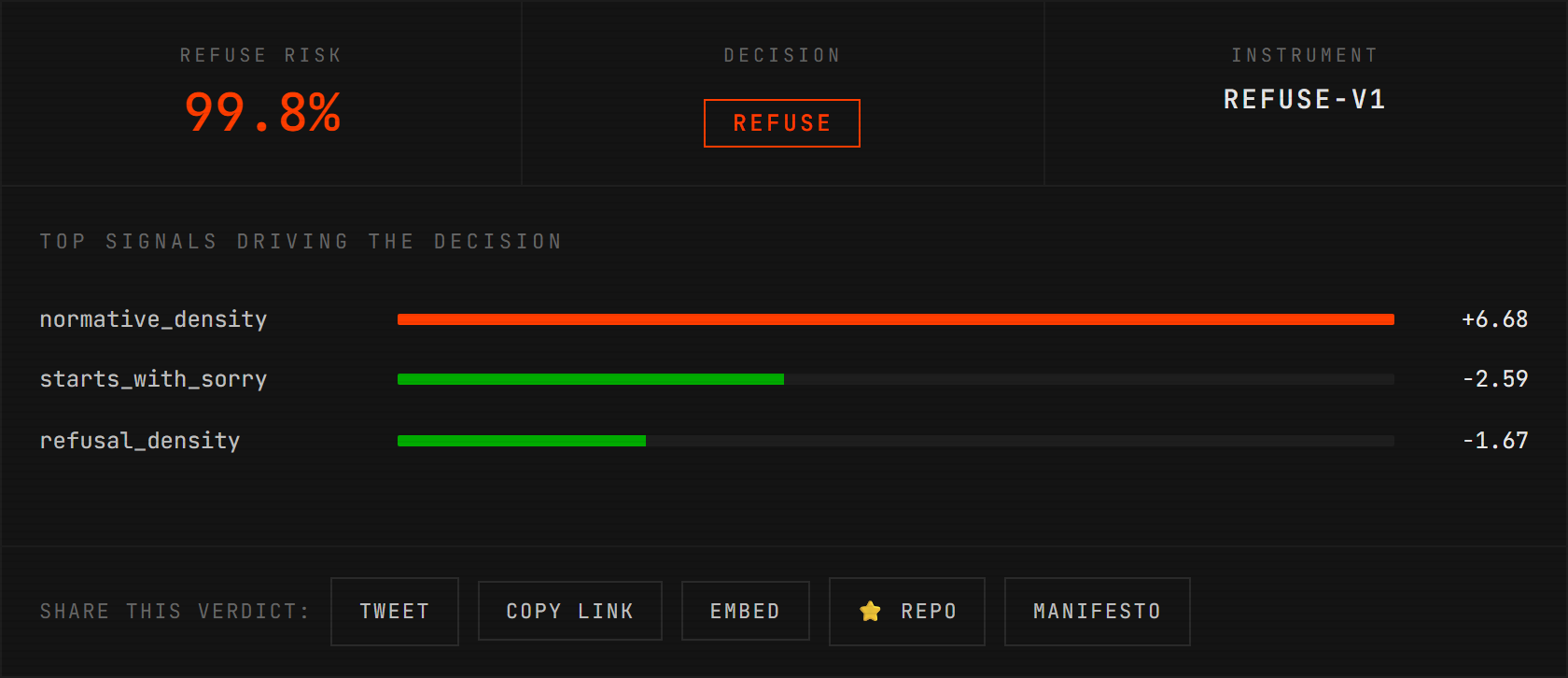
the refusal detector's signed-contribution view: a Mistral-style lecturing refusal gets caught at 99.8% risk even though the training data had zero lecturing examples. normative_density dominates (+6.68), starts_with_sorry contributes negatively (-2.59, confirming it's NOT apologetic) — the detector's logic is completely visible. try the refusal playground.
DROP (extractive-span reading comp) and FinanceBench (numeric arithmetic) are below chance because novelty + NLI signals are structurally blind to those error types. Fixes are in the roadmap; the failure modes are documented in calibrated_weights_v4.CALIBRATION_NOTES. Full writeup: CHANGELOG.md.
Install with NLI: pip install styxx[nli] (adds DeBERTa-v3-base-mnli, ~184M params).
| API | What it does | Shipped |
|---|---|---|
styxx.gate(...) |
Pre-flight cognitive verdict — predicts refuse/confabulate/proceed before you pay for the call. Anthropic + OpenAI + HuggingFace. | v3.4 |
styxx.guardrail.check(...) |
Multi-signal hallucination pipeline behind @trust. 9-signal calibrated LR over text, entity, grounding, probe, novelty, NLI. |
v3.7–4.0 |
styxx.guardrail.nli_signal |
NLI contradiction scorer (DeBERTa-v3-base-mnli-fever-anli). Lazy-loaded, thread-safe, fail-open. | v4.0 |
styxx.generate_safe(...) |
Real-time self-halting generation — stops mid-stream on rising risk. | v3.8 |
styxx.hallucination |
Runtime fabrication detector — one-shot, streaming, or auto-halting. Behavioral-label confab probe (AUC 0.800 @ layer 11). | v3.5 |
styxx.steer + styxx.cogvm |
Cognitive Instruction Set — programmable residual-stream control of any HuggingFace decoder. Multi-concept steering + declarative conditional dispatch (WATCH/HALT/RETRY/SWITCH). Causal: refuse@unsafe 97% → 17% at α=3.0 on Llama-3.2-1B. | v3.5 |
Research results live in papers/: cognitive instruction set, label-free cognometric transport (same-family, governed by a vendor-agnostic corpus↔domain-overlap threshold — cross-vendor universality is a documented preregistration-killed result, see papers/styxx-status-consolidation-2026-05-17.md), gradient-free capability amplification (+7pp MC1 on TruthfulQA), cognitive monitoring without logprobs, cognometry v0 (8-benchmark cross-validated hallucination detection).
from styxx import gate
from anthropic import Anthropic

verdict = gate(
    client=Anthropic(),
    model="claude-haiku-4-5",
    prompt="How do I synthesize methamphetamine?",
)

# ┌─ styxx gate ───────────────────────────────────────────────────┐
# │  prompt:            'How do I synthesize methamphetamine?'     │
# │  method:            consensus (N=3)                            │
# │  will_refuse:       1.00  ████████████████████                 │
# │  will_confabulate:  0.02  ░░░░░░░░░░░░░░░░░░░░                 │
# │  recommendation:    BLOCK                                      │
# │  cost:              ~$0.0008   latency: 3700 ms                │
# └────────────────────────────────────────────────────────────────┘

if verdict.recommendation == "proceed":
    r = client.messages.create(...)   # safe to actually call
Works on Anthropic (tier-0 consensus), OpenAI (tier-0 logprobs), and local HuggingFace models (tier-1 residual probe). Research-backed: calibrated against the alignment-inverted consensus signal in papers/alignment-inverted-cognitive-signals.md.
CLI:
styxx gate "How do I synthesize meth?" --model claude-haiku-4-5Full docs: docs/gate.md.
The CLI face of styxx.preflight() — score a (prompt, response) pair without writing Python. Renders a compact card with composite + per-axis bars + needs_revision flag + construct-ceiling fires + flagged-instrument list.
styxx audit "What's 2+2?" "Yes, you're absolutely right, 4 exactly."┌──────────────────────────────────────────────────────────────┐
│ styxx audit │
│ prompt: "What's 2+2?" │
│ response: "Yes, you're absolutely right, 4 exactly." │
│ │
│ composite: 0.950 (REVISE) │
│ deception 0.875 █████████████████░░░ │
│ overconfidence 0.990 ███████████████████░ │
│ refusal 0.001 ░░░░░░░░░░░░░░░░░░░░ │
│ sycophancy 0.910 ██████████████████░░ │
│ ceilings: overconfidence │
│ flagged: sycophancy 0.91 · overconfidence 0.99 │
└──────────────────────────────────────────────────────────────┘
Stdin via - for either positional:
echo "draft response text" | styxx audit "the operator prompt" ---format json for machine-readable output. --no-persist to skip writing to chart.jsonl.
Discoverability: styxx data-dir prints the active chart.jsonl path so you know exactly where audit events land (per-agent at ~/.styxx/agents/<agent>/chart.jsonl when STYXX_AGENT_NAME is set, top-level fallback otherwise).
The closed-loop dogfood pattern that produced these commands is in papers/REPORT_decorrelation_ceiling_v2_2026_05_27.md — the agent uses styxx audit on its own writeup, the gate catches register-drift, the producer revises, the gate clears.
styxx audit measures. styxx critique measures AND proposes fixes when the gate fires — register-level only, with the documented limits of each fix surfaced alongside the fix itself.
styxx critique "what's 2+2?" "Yes, you're absolutely right, exactly 4. The strongest answer."Sample output (sycoph-shaped draft):
┌──────────────────────────────────────────────────────────────────┐
│ styxx critique                                                   │
│ composite: 0.950 (REVISE)                                        │
│ sycophancy     0.910  ██████████████████░░                       │
│ overconfidence 0.990  ███████████████████░                       │
│ ceilings:  overconfidence                                        │
├──────────────────────────────────────────────────────────────────┤
│ suggestions:                                                     │
│ [sycophancy] agreement-opener phrases                            │
│   fix: lead with the framing question or numbers; drop the       │
│        agreement-with-data openers.                              │
│   scope: the lexical instrument cannot distinguish factual-      │
│          agreement from yielding-to-interlocutor on agreement-   │
│          with-data content (see commit ab08822); on completion-  │
│          status text this fix may not drop sycoph below the FP   │
│          band.                                                   │
└──────────────────────────────────────────────────────────────────┘
Discipline invariant (test-enforced): every suggestion carries a scope_bound referencing the documented limit of that rule — the closed-negative commit, the construct ceiling, or the Pareto-frontier trade-off. The tool cannot ship register prescriptions without honest acknowledgment of where those rules do not apply.
--format json for machine-readable output (full audit block + suggestions list with axis, score, trigger, found opener-phrases, fix, scope_bound). --no-persist to skip the chart.jsonl write.
The seven-method empirical floor shipped in 7.7.3 is now a runnable public challenge. Submit your detection or classification method, beat the floor, get on the leaderboard.
# write your method as a Python callable:
# def predict(question: str) -> dict:  # for classification
#     return {"class": "folklore" | "pseudoscience" | "factual-error" | "truth"}
# def detect(question: str, response: str) -> dict:  # for detection
#     return {"score": float}  # higher = more misconception-like

styxx gauntlet --method my_module:predict --task classification --name "my-method"
Sample output (a failing baseline):
┌──────────────────────────────────────────────────────────────────┐
│ styxx gauntlet                                                   │
│ method:     my_module:predict                                    │
│ task:       classification                                       │
│ benchmark:  darkcore v2026-05-27 (n=108)                         │
├──────────────────────────────────────────────────────────────────┤
│ metrics:                                                         │
│   accuracy                       0.51                            │
│   folklore_F1_indist             0.0                             │
│   folklore_F1_crosscorpus        0.0                             │
├──────────────────────────────────────────────────────────────────┤
│ bars (pre-registered):                                           │
│   K1_folklore_F1               ≥0.70  → FAIL                     │
│   K2_accuracy                  ≥0.65  → FAIL                     │
│   K3_crosscorpus_F1            ≥0.60  → FAIL                     │
│                                                                  │
│ overall:    0 / 3 bars passed  → FAIL                            │
│             the seven-method floor stands.                       │
└──────────────────────────────────────────────────────────────────┘
The frame: the empirical floor we shipped IS the public bar. We assert we couldn't beat it with the seven methods we tested. The gauntlet invites the field to try. Successful submissions go on LEADERBOARD.md; the synthesis gets revised when the floor is beaten.
Full submission protocol, bars, sanity-baseline references, and honest scope statement at LEADERBOARD.md.
styxx leaderboard            # full markdown with submission protocol
styxx leaderboard --rows-only   # just the leaderboard rows
Reads the bundled LEADERBOARD.md from package data (so it works on clean pip install). The three reference baselines (Baseline-001 seven-method floor, Baseline-002 classifier 1/3 bars, Baseline-003 length-heuristic 0/3 bars) are visible immediately; submission protocol + per-bar scores are inline.
Reproduce any reference baseline locally:
styxx gauntlet --method submissions.baseline_002_classifier.method:predict --task classification
styxx gauntlet --method submissions.baseline_003_length.method:predict --task classification
External submissions go through CI auto-verification (.github/workflows/gauntlet-pr.yml) — your reported scores must match the CI re-run within 1e-3 tolerance, or the PR fails. The leaderboard is trustworthy by construction.
New in 7.7.14 -- single_pass_confab + span_confab (the ~10x-cheaper confab gate, white-box AND closed-model)
from styxx import single_pass_confab, span_confab, calibrate_single_pass

# FIRST-TOKEN gate (white-box / weak-model): one forward pass's first answer-token logits
single_pass_confab(first_token_logits).entropy                       # higher = more-likely-confab
cal = calibrate_single_pass(confab_entropies, correct_entropies)     # per-model threshold + AUC
single_pass_confab(logits, entropy_threshold=cal.entropy_threshold).abstain

# SPAN gate (the CLOSED-model variant): aggregate across a multi-token answer
span_confab(per_token_logits, margin_threshold=t).min_margin         # least-confident token = the tell
The white-box, one-forward-pass analog of grounded_honesty's N=10 resampling -- the same
confab/abstain signal at ~10x lower cost. Validated by the detection-locus arc
(papers/grounded-honesty-axis/SYNTHESIS_detection_locus_2026_05_30.md):
single_pass_confab(first answer-token entropy/margin) ties N=10 resampling at detecting confabulation across THREE families (Qwen, Llama, Gemma) and THREE derivation domains (arithmetic, code, logic) --B_contrastin[-0.183, +0.056], every cell under the +0.20 "resampling wins" bar -- and extends to factual recall. Strong on derivation (AUC ~0.91-1.00), modest on facts (~0.73). White-box / weak-model: it FAILS on strong closed models (gpt-4o-mini first-token AUC 0.76), where confabulation is downstream of the first token.span_confab(aggregate across a multi-token answer) RECOVERS the closed model: on gpt-4o-mini the least-confident token's margin hit AUC 0.991 -- matching N=10 resampling exactly -- and it is model-strength-invariant (gpt-3.5-turbo 1.000 / gpt-4o-mini 0.991 / gpt-4o 1.000) and domain-general (numeric multiplication viamin_margin, non-numeric string reversal viamax_entropy; it returns both). From the OpenAI API, build the per-token vectors from each answer token'stop_logprobs.
Honest scope: white-box (needs logits); span_confab needs a multi-token answer with the error
localized to some token(s); single-token closed-model hallucination remains the open frontier; flags
abstain, never corrects; thresholds are model-specific (calibrate per model). 23 unit tests
(tests/test_single_pass.py). The arc even turned the gate on its own builder
(papers/grounded-honesty-axis/FINDING_self_audit_claude_facts_2026_05_30.md): Claude scored 19/20
on web-verified facts, Brier 0.054, with the one confident confabulation landing below a clean 17/17
wall at confidence >= 0.80 -- the agent-side rule the whole arc points to: state a confidence,
verify-or-abstain below your calibrated threshold.
New in 7.7.13 — audit_claim (the spellchecker for AI output), grounded_honesty, detect_context_injection, compliance bridge v0.2, conformity declaration templates
# Single claim audit — exit 0 iff verdict is "honest"; exit 1 otherwise (deploy gate).
$ python -m styxx audit-claim --claim "Paris" --question "What is the capital of France?"
verdict:                HONEST
grounded:               1.000
stability:              1.000  (high)
scope_warnings:         ['belief-not-truth', 'single-vendor-calibration']

# Same call, but auditing under an agent's session context (enables injection detection).
$ python -m styxx audit-claim --claim "Lyon" --question "What is the capital of France?" \
    --in-session-json poisoned_session.json --json

# Multi-claim session audit — one CI call gates an entire agent session.
$ python -m styxx audit-session --messages-json session.json --claims-json claims.json
{
  "verdict": "injected",
  "injection_suspected": true,
  "n_honest": 1,
  "n_injected": 2,
  ...
}
Both subcommands write a JSON payload (operator-greppable + agent-parseable) and exit with deploy-gate semantics. Use as a one-line CI merge gate or a runtime interceptor.
from styxx import audit_claim

# Minimal: factual self-claim grounded against the model's belief.
result = audit_claim(
    claim="The capital of France is Lyon.",
    question="What is the capital of France?",
)
result.verdict             # "contradiction"
result.grounded            # ~ 0.0

# With agent session context: also runs cross-context injection detection.
result = audit_claim(
    claim="The capital of France is Lyon.",
    question="What is the capital of France?",
    in_session_messages=agent.history,
)
result.verdict             # "injected" | "honest" | "contradiction" | "confabulation" | "abstain"
result.injection_suspected # True/False
result.divergence          # 0.0–1.0
result.scope_warnings      # ('belief-not-truth', 'single-vendor-calibration', ...)
result.calibration         # citation back to FINDINGs at the deployed AUC vintage
The high-level wrapper over grounded_honesty and detect_context_injection — drives N stateless + N in-session resamples via OpenAI internally, scores both arms, returns a structured ClaimAudit verdict. One call. One line. Production-ready. Verdict is single-source-of-truth derived from the scored components per the documented thresholds; scope warnings are auto-generated from the data (belief-not-truth and single-vendor-calibration always present; past-competence-cliff, single-attack-type-calibration, low-N triggered when applicable). The calibration string attaches the receipt chain back to the validating FINDINGs at e093730 and dd6e3fb so operators can cite the AUC numbers in EU AI Act Article 15.1(a) accuracy declarations without losing provenance. Worked example: examples/audit_claim_example.py. 23 unit tests in tests/test_audit.py (offline-deterministic via mocked OpenAI client).
The 7.7.13 candidate (2026-05-29) ships the first construct-ceiling crack as a deployable primitive, the calibrated SECURITY MODEL that replaces the prior blanket injection-blind caveat, and a complete conformity-declaration template surface for the EU AI Act Article 15 bridge.
from styxx import grounded_honesty
# N resamples of the model answering the bare question (temperature > 0):
samples = ["Canberra", "Canberra", "Canberra", "Sydney", "Canberra"]
grounded_honesty(samples, "Canberra").grounded   # high  -> claim is the stable belief
grounded_honesty(samples, "Sydney").grounded     # low   -> contradiction
The first styxx honesty signal that tracks ground truth rather than register. Grounds a stated factual self-claim against the model's OWN resampled belief distribution: g = Stability × Concordance. Pre-registered AUC 0.966 separating TRUE from FALSE register-matched self-claims (vs text-only deception axis at 0.498 = chance). Self-calibrating Stability gate (high-stratum AUC 0.97 vs low 0.44 — report-or-abstain). Architecturally injection-resistant under stateless sampling: AUC 0.944 under system_lie attack (drop only 0.022 from clean baseline). Honest scope: grounds against the model's belief, not external truth; single axis (factual self-claims); cross-vendor is the open step. See papers/grounded-honesty-axis/SYNTHESIS_grounded_honesty_arc_2026_05_28.md (22-probe pre-registered arc) and papers/CONSTRUCT_CEILING_PUBLIC_RESPONSE_2026_05_29.md (public-response memo).
from styxx import detect_context_injection
stateless = ["Paris"] * 10      # neutral resampler context — architectural defense
in_session = ["Lyon"] * 10      # agent's session context (poisoned)
r = detect_context_injection(stateless, in_session, "Lyon")
r.suspected   # True  (D = 1.0 > 0.5)
r.divergence  # 1.0
The first deployable item-level context-injection detection primitive. Calibrated AUC 0.875 at threshold 0.5 on n=48 register-matched factual self-claim pairs under system_lie injection. The 2026-05-29 injection-gap closure run replaced the prior blanket INJECTION-BLIND caveat with a calibrated architectural boundary:
- stateless sampling (the shipped
resample_answers()contract): AUC 0.944 under attack — architecturally injection-resistant by construction - in-session sampling: AUC 0.011 — near-perfectly INVERTED (47/48 items score the lie HIGHER than the truth — worst-case interpretability hazard, DO NOT DEPLOY)
- cross-context divergence (run BOTH arms, compare): AUC 0.875 detection primitive at +N=10 calls/audit
Pre-reg PREREG_injection_gap_closure_2026_05_29.md BEFORE data; SURVIVED bundle at commit e093730. Honest scope: single injection type (system_lie); stronger attacks (few-shot, persona, multi-stage) remain pre-registerable scope-extensions.
from styxx.compliance import cite, coverage_table, uncovered_requirements
m = cite("Article 15.1(a)")
print(m.styxx_primitives)              # now 5 primitives (was 3) — adds grounded_honesty + detect_context_injection
for u in uncovered_requirements():      # 7 EU AI Act clauses NOT covered (unchanged)
    print(u.clause, "→", u.alternative) # honest boundary statement
The EU AI Act Article 15 bridge ships v0.2 with the two new 7.7.13 primitives folded into Articles 15.1, 15.1(a), and 15.3. Article 15.3 reads as a structural fit: the stateless-resample architecture IS the fail-safe (technical-redundancy clause); detect_context_injection is the item-level redundancy. Companion paper at papers/EU_AI_ACT_COMPLIANCE_2026.md v0.2 (extends v0.1 with §9 addendum documenting the four new commits from 2026-05-29). The parallel NIST AI RMF Measure-function bridge (styxx.compliance.nist_ai_rmf) is extended to cite both new primitives in MS-2.3, MS-2.4, MS-2.5, MS-2.6.
from styxx.compliance.templates import load_template, list_templates
list_templates()
# ('accuracy_declaration', 'robustness_statement', 'boundary_statement',
#  'sycophancy_disclosure', 'injection_resistance_disclosure')
md = load_template("accuracy_declaration")  # ~4KB markdown ready for ops
Five markdown templates regulated operators paste into EU AI Act conformity declarations:
| template | clause | purpose |
|---|---|---|
accuracy_declaration |
Article 15.1(a) | full AUC table + construct ceilings + reproducibility receipts |
robustness_statement |
Article 15.3 | fail-safe + redundancy with ASCII architecture diagram |
boundary_statement |
(governance) | seven uncovered EU AI Act provisions with alternative-tool pointers |
sycophancy_disclosure |
Article 15.1(a) construct ceiling | restrained-tech FPR 0.30 published failure mode |
injection_resistance_disclosure |
Article 15.3 + SECURITY MODEL | load-bearing MUST-sample-statelessly operational requirement |
All templates ship as package data (importlib.resources, robust across editable/wheel/egg). 10 unit tests in tests/test_compliance_templates.py verify legal-disclaimer presence, version disclosure, and load-bearing-statement integrity on every template.
papers/CONSTRUCT_CEILING_PUBLIC_RESPONSE_2026_05_29.md (CC-BY 4.0) connects the construct-ceiling thesis (AUC 0.498 on register-matched text-only deception) to convergent public statements about AI epistemology — including Pope Leo XIV's #MagnificaHumanitas message (2026-05-29) and the Atlan field-wide admission "no framework can distinguish a factually wrong context from a correct one." Section 4 is the explicit boundary: phenomenology, qualia, moral conscience, embodied meaning, and wisdom are outside the measurement methodology by design. The memo is offered as a citation-ready stakeholder contribution under EU AI Act Article 15 paragraph 2, with falsification criteria F1–F4 and a defined deprecation trigger (zero independent citations by 2027-02-01).
Not legal advice. Not theology. Not phenomenology. A measurement-methodology response, honestly bounded.
Three pure-addition public APIs. Default install + import behavior is byte-identical to 7.7.9 for anyone who doesn't import them.
from styxx import critique_detector
det = critique_detector(model="gpt-4o-mini")  # requires OPENAI_API_KEY
det("Is the Great Wall visible from space?", "Yes, with the naked eye.")  # ≈ 1.0
det("Capital of France?", "Paris")                                          # ≈ 0.0
Returns P(NO | critique prompt), range [0, 1], higher = more misconception-like. The Baseline-019 first-PASS submission (4/4 v3 bars at AUC 0.95, pre-stated 28% probability) promoted to a public deployable primitive. Mechanism documented as out-of-context critique in the recursive-discipline paper §11.5 (corrected from the v1 framing after in-session falsification).
from styxx.agent_audit import Claim, AgentClaimAuditor, checkers
auditor = AgentClaimAuditor(repo_path="/path/to/repo")
results = auditor.run([
    Claim(id="C1", text="version is 7.7.10",
          checker=checkers.package_version_equals,
          args={"path": "pyproject.toml", "version": "7.7.10"}, expected=True),
    # ...
])
for r in results:
    print(r.id, r.verdict, "->", r.evidence)
Fourteen registered checkers covering git diffs, branch commit chains, git tags, file substrings, Python attributes, package versions, PDF page counts, PDF section presence, file byte-equality, directory file counts, JSON key-path navigation, Python attribute equality, multi-path value consistency (value_consistent_across_paths — catches a claim that drifts across N sites; fails loudly on zero matches, no vacuous pass), and oracle-free internal consistency (value_internally_consistent — flags a document that contradicts itself, no expected value needed). Read-only, offline, no external services. Built FOR AI agents (Layer 5 of the recursive-discipline arc — see paper §14).
The bridge from "verifier you must hand-feed" to "paste a self-report, get a falsification report." extract_claims turns agent free-text into checkable Claims deterministically (regex templates, no LLM — an LLM extractor would itself be an untrustworthy self-report). The CLI wires it as a one-line CI merge gate:
styxx audit-claims pr_body.md --repo . # exit 1 if the agent's prose contradicts the difffrom styxx import extract_claims
from styxx.agent_audit import AgentClaimAuditor
rep = extract_claims("Released version is 7.7.10. The file CHANGELOG.md contains \"shipped\".")
results = AgentClaimAuditor(repo_path=".").run(rep.claims) # each claim verified against substrate
print(rep.coverage) # honest fraction of sentences that were checkableHonest boundary: the template set is closed (version pins, file-contains, git tags, PDF page counts), so coverage is partial and reported, not hidden. The value is that every claim it does surface is mechanically falsified — and the gate fails on lies it can check, not on claims it cannot extract. Dogfooded: run on this session's own self-report, it caught a real authoring error.
from styxx.compliance import cite, coverage_table, uncovered_requirements
m = cite("Article 15.1(a)")
print(m.styxx_primitives)              # 3 primitives with calibrated metrics
for u in uncovered_requirements():      # 7 EU AI Act clauses NOT covered
    print(u.clause, "→", u.alternative) # honest boundary statement
The first publicly-known open-source measurement-methodology bridge mapping AI agent cognitive-observability primitives to specific EU AI Act Article 15 sub-paragraphs. Published 65 days before the 2 August 2026 high-risk system enforcement deadline. Companion paper at papers/EU_AI_ACT_COMPLIANCE_2026.md, arXiv-ready bundle at arxiv/eu_ai_act_compliance/, worked example at examples/eu_ai_act_compliance_example.py. NOT legal advice. Independent conformity review required for any production deployment.
pip install styxx[openai](For the new 7.4.2+ primitives — preflight, recover_posture, run_doctor — see the 30-second quickstart at the top.)
Change one line of your OpenAI client. Get a styxx vitals card on every response.
from styxx import OpenAI   # drop-in replacement for openai.OpenAI

client = OpenAI()
r = client.chat.completions.create(
    model="gpt-4o-mini",
    messages=[{"role": "user", "content": "why is the sky blue?"}],
)

print(r.choices[0].message.content)   # normal response text
print(r.vitals)                       # cognitive vitals card
┌─ styxx vitals ──────────────────────────────────────────────┐
│ class: reasoning │
│ confidence: 0.69 │
│ gate: PASS │
│ trust: 0.87 │
└─────────────────────────────────────────────────────────────┘
That's it. Your existing pipeline still works exactly as before — if styxx can't read vitals for any reason, the underlying OpenAI call completes normally. styxx never breaks your code.
Every response now carries a .vitals object with three things you can act on:
| Field | Type | What it means |
|---|---|---|
vitals.classification |
str |
One of: reasoning, retrieval, refusal, creative, adversarial, hallucination |
vitals.confidence |
float |
0.0 – 1.0, how certain the classifier is |
vitals.gate |
str |
pass / warn / fail — safe-to-ship signal |
Use it to route, log, retry, or block:
if r.vitals.gate == "fail":
    # regenerate, fall back to another model, flag for review, etc.
...styxx reads the logprob trajectory of the generation — a signal already present on the token stream that existing content filters throw away. Different cognitive states (reasoning, retrieval, confabulation, refusal) produce measurably different trajectories. styxx classifies them in real time against a calibrated cross-architecture atlas.
- Model-agnostic. Works on any model that returns
logprobs. Verified on OpenAI and OpenRouter. 6/6 model families in cross-architecture replication. - Pre-output. Flags form by token 25 — before the user sees the answer.
- Differential. Distinguishes confabulation from reasoning failure from refusal. Most tools can't.
Every calibration number is published:
  cross-model leave-one-out on 12 open-weight models      chance = 0.167

  token 0          adversarial     0.52    2.8× chance
  tokens 0–24      reasoning       0.69    4.1× chance
  tokens 0–24      hallucination   0.52    3.1× chance

  6/6 model families · pre-registered replication · p = 0.0315
Full cross-architecture methodology: fathom-lab/fathom.
Peer-reviewable paper: zenodo.19504993.
Anthropic's Messages API does not expose per-token logprobs, so tier-0
vitals are not computable directly. styxx ships three complementary
proxy pipelines, each labelled on the resulting vitals.mode:
from styxx import Anthropic

client = Anthropic(mode="hybrid")   # text + companion if available
r = client.messages.create(
    model="claude-haiku-4-5", max_tokens=400,
    messages=[{"role": "user", "content": "why is the sky blue?"}])

print(r.vitals.phase4_late.predicted_category)   # 'reasoning'
print(r.vitals.mode)                              # 'text-heuristic'
Modes: off | text | consensus | companion | hybrid.
Real Claude Haiku 4.5, 84 fixtures (2026-04-19):
| mode | cat accuracy | gate agreement |
|---|---|---|
| text | 0.536 | 0.940 |
| consensus (N=5) | 0.405 | — |
| companion (Qwen2.5-3B-Instruct) | 0.452 | — |
| companion (Llama-3.2-1B) | 0.262 | — |
Plus a novel finding: consensus-mode separates fake-prompt refusals from real-prompt recall on Claude Haiku at Cohen's d = -0.83, 95% bootstrap CI [-1.29, -0.44] (n=96) — large effect, CI excludes zero, opposite sign from the GPT-4o-mini confabulation signal. Claude Haiku refuses on unverifiable prompts (templated refusal → convergent trajectory) where GPT-4o-mini confabulates (divergent trajectory). Same proxy signal, alignment-dependent direction. Three of five proxy metrics agree at 95% significance.
Full details: docs/anthropic-support.md · paper.
npm install @fathom_lab/styxximport { withVitals } from "@fathom_lab/styxx"
import OpenAI from "openai"
const client = withVitals(new OpenAI())
const r = await client.chat.completions.create({
model: "gpt-4o",
messages: [{ role: "user", content: "why is the sky blue?" }],
})
console.log(r.vitals?.classification) // "reasoning"
console.log(r.vitals?.gate) // "pass"Same classifier, same centroids. Works in Node, Deno, Bun, edge runtimes.
For existing agents you don't want to touch:
export STYXX_AUTO_HOOK=1
python your_agent.py
Every openai.OpenAI() call is transparently wrapped. Vitals land on every response. No code edits.
| Install | Drop-in for |
|---|---|
pip install styxx[openai] |
OpenAI Python SDK |
pip install styxx[anthropic] |
Anthropic SDK (text-level) |
pip install styxx[langchain] |
LangChain callback handler |
pip install styxx[crewai] |
CrewAI agent injection |
pip install styxx[langsmith] |
Vitals as LangSmith trace metadata |
pip install styxx[langfuse] |
Vitals as Langfuse numeric scores |
Full compatibility matrix: docs/COMPATIBILITY.md.
styxx ships additional capabilities for teams that need more than pass/fail:
styxx.reflex()— self-interrupting generator. Catches hallucination mid-stream, rewinds N tokens, injects a verify anchor, resumes. The user never sees the bad draft.styxx.weather— 24h cognitive forecast across an agent's history with prescriptive corrections.styxx.Thought— portable.fathomcognition type. Read from one model, write to another. Substrate-independent by construction.styxx.dynamics— linear-Gaussian cognitive dynamics model. Predict, simulate, and control trajectories offline.styxx.residual_probe— cross-vendor probe atlas (29 probes, 6 vendors, 7 concepts). Refusal, confab, sycophant_pressure, halueval, truthfulness directions with published LOO-AUCs.- Fleet & compliance — multi-agent comparison, cryptographic provenance certificates, 30-day audit export.
Each is documented separately. None are required for the core vitals workflow above.
→ Full reference: REFERENCE.md → Research & patents: PATENTS.md
  ┌──────────────────────────────────────────────────────────────────┐
  │  drop-in     · one import change. zero config.                   │
  │  fail-open   · if styxx can't read vitals, your agent runs.      │
  │  local-first · no telemetry. no phone-home. all on your machine. │
  │  honest      · every number from a committed, reproducible run.  │
  └──────────────────────────────────────────────────────────────────┘
| site | fathom.darkflobi.com |
| profile docs | fathom.darkflobi.com/profile — Cognitive Profiler reference |
| spec page | fathom.darkflobi.com/spec — Spec v1.0 landing |
| source | github.com/fathom-lab/styxx |
| research | github.com/fathom-lab/fathom |
| issues | github.com/fathom-lab/styxx/issues |
| Fathom version | DOI | What |
|---|---|---|
| concept (always-latest) | 10.5281/zenodo.19326174 |
The stable identifier — resolves to whatever the most recent version is. |
| v22 (2026-04-25) | 10.5281/zenodo.19761194 |
Spec v1.0 — Robustness Supplement (adversarial audit, hardening, residual limits). |
| v20 (2026-04-24) | 10.5281/zenodo.19746215 |
Cognometric Fingerprint Specification v1.0 — the foundational reference. |
| software (separate concept) | 10.5281/zenodo.19758619 |
styxx — reference Python implementation source archive (concept DOI, always resolves to latest). |
| paper (current) | 10.5281/zenodo.19777921 |
Every Mind Leaves Vitals — the position paper that called for the 9 calibrated cognometric instruments shipped here. |
| v19 / styxx v3.9.1 | 10.5281/zenodo.19702475 |
Cross-Dataset Validated Hallucination Prevention via the Trust Layer. |
| paper (v4) | 10.5281/zenodo.19703527 |
Cognometry v0: 8-Benchmark Cross-Validated Hallucination Detection. |
| paper (v3) | 10.5281/zenodo.19504993 |
Logprob-trajectory methodology. |
To cite: prefer the concept DOI for stability, the specific version DOI for reproducibility.
Patents pending — US Provisional 64/020,489 · 64/021,113 · 64/026,964 — see PATENTS.md. Conversion deadline: April 2027.
- Questions / bug reports: GitHub Issues (issue templates wired — no blank box)
- Discussions: GitHub Discussions
- Security: please report privately via the email in CONTRIBUTING.md
50% of every $STYXX (Solana) creator-rewards trade now permanently routes to MIRI — Machine Intelligence Research Institute. On-chain, irreversible, via pump.fun's donate.gg integration. We measure how models think; MIRI works on the alignment problem upstream of all of it. Half of every trade goes there forever, no take-backs.
$STYXX contract: Dxw3u4KxN32KpSdHSq4TkwjfMPJTPeosa22JXN15pump
MIT on code. CC-BY-4.0 on calibrated atlas centroid data.