| HACKATHON : 3-5/02/2025 |

|
TEAM simulation |


Radio interferometric imaging uses interferometers to measure visibilities, which are samples of the sky obtained from pairs of antennas. To transform these visibilities into an image of the sky, imaging algorithms generally use two main steps: a major loop (∆) and a minor loop (Ψ).
- The major loop (∆) manages the transformation of the visibilities into a dirty image of the sky via gridding and screening operations.
Griddingconsists of projecting the visibilities onto a regular grid in the uv plane in order to facilitate the application of the Fast Fourier Transform (FFT) to generate a dirty image.Degriddingperforms the opposite operation, comparing the visibilities calculated from an image model and adjusting them accordingly. - The minor loop (Ψ) is used to clean the dirty image of artefacts introduced by the instrumentation. Of the algorithms available, Clean by Hogbom [2] is the most commonly used. This algorithm first identifies the dominant sources in the dirty image, then models these sources while removing the artefacts associated with the instrumental response (PSF). Finally, the image is updated iteratively until it converges on a clean version.
By combining these two loops, it is possible to obtain an accurate image of the sky from the raw data provided by the interferometer.

|

|
Most interferometric imagers (ddfacet, sep, generic imaging pipeline etc) take a MeasurementSet *.ms file as input and generate an image as output. The most commonly used format is Flexible Image Transport System (FITS) *.fits.
As we are keen to benchmark the performance of our pipelines over a wide range of case studies, and as we don't have access to telescopes, we are going to generate our own MeasurementSet on which we will have control over the configuration of the instruments and the image of the true sky.
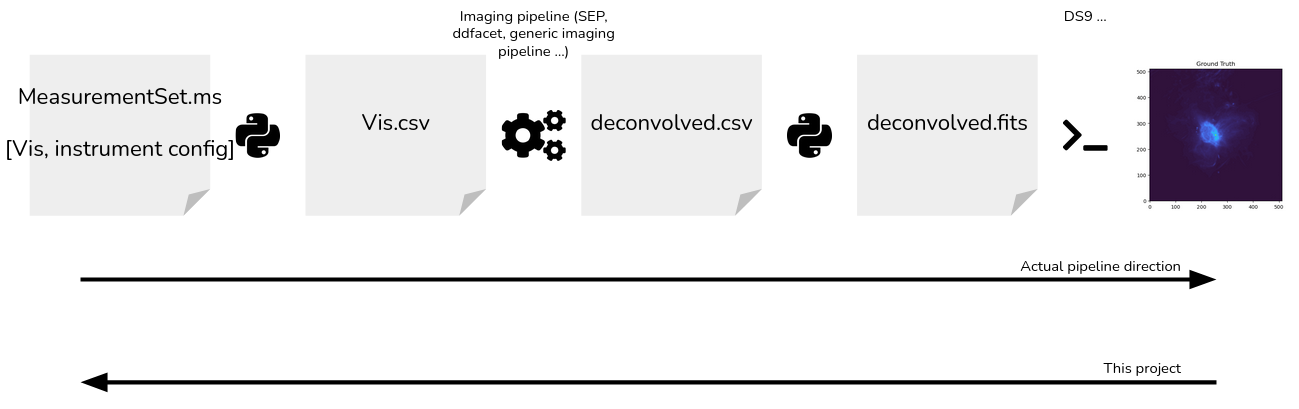
This project aim to create visibilities.ms from output.fits image which correspond to the reverse steps of standard radio-astronomy imaging pipeline.
This project contains two implementation of the MS simulator:
This simulator is based on RASCIL degridder and SKAO SDP libraries. It allow to generate distributed measurementSet from a given true sky image considering interferometer configuration such as the MEERKAT telescope among others.
📌 All the process are contained in the notebook distributed_ms_from_fits_rascil except the ska_sdp_datamodels and ska-sdp-func-python install them before benefiting from this project.
git clone https://gitlab.com/ska-telescope/sdp/ska-sdp-datamodels.git
cd ska_sdp_datamodels
pip install --extra-index-url https://artefact.skao.int/repository/pypi-internal/simple ska-telmodel
pip install .
cd ..

git clone https://gitlab.com/ska-telescope/sdp/ska-sdp-func-python.git
cd ska-sdp-func-python
pip install .
cd..

pip install python-casacore

pip install notebook

jupyter notebookThis simulator is based on a standard dataflow degridder used in the Generic Imaging Pipeline (GIP) and the SDP evolutionary pipeline (SEP). It allow to generate visibilities from a custom true sky image.
Parameterized implementations of the GIP has been proposed in this repository: ➡️ simsdp-generic-imaging-pipeline (submitted to GRETSI 2025) . This result in a parametric executable: ./Pipeline <NUM_VIS> <GRID_SIZE> <NUM_MINOR_CYCLE>. This assumes that the true sky image is also parametric, which is the purpose of this simulator. These two parametric components will allow to facilitate algorithm exploration to identify the parameters and configuration that block the scaling on HPC systems.
📌 All the process are contained in the notebook ms_from_fits_dataflow executing the parametric executable.
cd dataflow_simulator/code/
cmake .
make
cd ..
jupyter notebook├── dataflow_simulator/
├── code/ #single thread dataflow based code in C
├── ms_from_fits_dataflow.ipynb # notebook to convert custom fits to visisbilty
├── doc/ # slides
├── example/ # image example
├── pic/ # project description pictures
├── skao_lib_simulator/
├── spectral_fits/ # generated spectral fits
├── spectral_ms/ # generated spectral ms*
├── distributed_ms_from_fits_rascil.ipynb # notebook to convert given fits into spectral fits into distributed ms
├──RP1C_transit.py # casacore based script to check ms validity
This hackathon comprises 2 phases:
- Phase 1: getting to grips with the SKA SDP libraries, generation of distributed MS, first test as ddfacet input, validation via casacore.
- Phase 2: generation of configurable MS, test as GIP input.
gantt
    title Plan
    dateFormat  YYYY-MM-DD
    axisFormat  %d %b
    section Hackathon
    Phase 1 :done, 2025-02-03, 2025-02-05
    MS generation: milestone, 2025-02-05
    Phase 2 :active, 2025-06-03, 2025-06-05
    Distributed MS : milestone, 2025-06-05
For questions or feedback, please contact:
The distributed_ms_from_fits_rascil notebook employ SKAO SDP libraries:
🔗 CASA --> section Types of images for the various spectral distribution
The ms_from_fits_dataflow notebook employ the std_degridding dataflow implementation:
📄 Generic imaging pipeline: S. Wang, N. Gac, H. Miomandre, J.-F. Nezan, K. Desnos, F. Orieux « An Initial Framework for Prototyping Radio-Interferometric Imaging Pipelines».
This project is part of the ECLAT labcom hackathon.
